Friday, March 8, 2013

Amakusa.

A few weeks ago I went with Caroline, Morgan, Christine (a 2010-2013 J-3), two Kumamoto pastors, a Luther High School student, and a Kyushu Lutheran College student to the Amakusa islands southwest of Kumamoto City. Amakusa is an area rich in nature, beauty, fresh sashimi, and Christian history, and we soaked it all in for an entire day. Here's some of what we learned.

Crossing one of the so-called Five Bridges of Amakusa on our journey in.

The Shimabara Rebellion.
Memorial at the Amakusa
Municipal Christian Museum.
European Christian missionaries first arrived in Japan in 1549, and their teachings, along with the goods they brought, were generally welcomed. But in 1582, the feudal lord Toyotomi Hideyoshi took power and, fearing a threat to his authority by such foreign influences, strictly prohibited Christianity. Hideyoshi ordered the death of many a Christian, including the public crucifixion of who are now known as the Twenty-six Martyrs of Japan in nearby Nagasaki.

Christian persecution continued sporadically for the next eighty years or so, as well as heavy tax burdens on the Amakusa area peasants. Punishments were harsh for those who couldn't pay--they were generally made to die horrible deaths. Discontent over persecution, taxes, and famine stirred up rebellion, and the charismatic 16-year-old Amakusa Shiro was chosen as leader in 1637.

Amakusa Shiro.
Statue of Amakusa Shiro outside the
Amakusa Municipal Christian Museum.
Photo by Caroline.
Born Masuda Shiro Tokisada, Amakusa Shiro was raised among Christians and was said to have mysterious powers from God. Supposedly he walked on water, and once had an egg containing a scroll of Scripture and a painting of Jesus fall into his hand. Many thought he was the fulfillment of a prophecy, made by a Catholic missionary who had been expelled some years earlier, that a "child of God" would come to save the people of Amakusa. Evidently Amakusa Shiro was a natural-born leader, as at the tender age of 16 he helped round up the citizens of Amakusa to try to attack Tomioka Castle. When that didn't work, they sailed to nearby Shimabara and barricaded themselves in the formerly abandoned Hara Castle.

Tomioka Christian Monument. May or may
not have the severed heads of some of the
1638 Shimabara rebels buried underneath it.
The number of Christians in that castle was about 37,000, including women and children who were willing to die for their faith, preferring to go to paraiso (paradise) than live in the hellish conditions brought on by unmerciful feudal lords. As time wore on, the rebels' food ran out and the government troops surrounding the castle grew to 125,000. Hara Castle finally fell on February 28, 1638. All the Christian rebels (except one suspected traitor) were beheaded, all believing they would be reunited in the Hereafter, safe in God's hands.

The Shimabara Rebellion was the largest rebellion as well as the largest religious war in Japan's history, and as such, changed the course of Japan's history for the next 200 years. Having seen firsthand the dangers of Christian teachings of human equality before God, the Japanese government officially closed off all exchange with foreign countries (with very limited exceptions) until 1853. Freedom of religion would not be instituted until 1873.

The Hidden Christians.
Amakusa Rosary Museum (foreground) and Ōe Catholic
Church (background), the latter established in 1880 after
Christianity was permitted, and rebuilt in 1933.
During the intervening years, Christian culture in Japan was calcified in the practice of the Kakure Kirishitan, or "Hidden Christians." They worshiped Jesus in secret, hiding crosses in seemingly Buddhist artifacts and praying in secret rooms. An innocent-looking hand mirror would project a cross onto the wall if held to reflect direct sunlight. A statue of Kannon, the Buddhist Goddess of Mercy, would really be a statue of Mary. When someone received a Buddhist blessing in the house, someone else would recite Christian prayers and pull a rosary in and out of a jar full of holy water in the secret room to neutralize the sutra.

Sakitsu Catholic Church, also established in
1880, rebuilt in 1934.
Sometimes these hidden Christians would be found out by means of fumi-e, or "stomping pictures." Officials would put a metal or wooden plate engraved with an image of the Virgin Mary or Jesus on the ground and challenge suspected Christians to step on it. If they refused, they were instantly arrested and killed for being a Christian. Many were martyred this way, and many lost their nerve and recanted, begging God for forgiveness later. The Hidden Christian culture remained well-preserved until the ban on Christianity was lifted in 1873 and Christian culture was once again allowed to flourish.

There is much more to this story, and I admit with my limited historical knowledge (and the limited availability of English-language materials) I may have gotten some details wrong, but it was still quite a moving experience to be in a place steeped in so much history. For a country that still largely views Christianity as foreign, Japan has quite a rich Christian heritage.

Scenic Amakusa.
From one man he made all the nations, that they should inhabit the whole earth; and he marked out their appointed times in history and the boundaries of their lands. God did this so that they would seek him and perhaps reach out for him and find him, though he is not far from any one of us.
Acts 17:26-27 (NIV)

Monday, February 18, 2013

Kumamoto life begins.

It's been a while since I've posted--over a month!--and for that I apologize. The past several weeks have been full of ups and downs, and several times over the past few weeks I've settled in to try and write a blog post only to erase the whole thing in frustration when I realized I had no idea what to say.

Near Kumamoto Lutheran Church.
Culture shock is probably the biggest culprit. They told us at orientation last July that it would hit about three months in--and they weren't kidding. Unfortunately it's not something you can really prepare for. For me it's manifested itself as an annoying brain fog, a general melancholy mood, and a tendency toward pessimism. It's especially apparent when I do things like go out to buy more toilet paper and realize painfully that the only other non-Japanese women downtown are the models on the sign outside the lingerie store. I've been watching much more American TV lately. (Thanks, iTunes! But I'm kind of running up a bill there now.)

Also, poor Caroline has been struggling the past few weeks after a one-two punch of a virus followed almost immediately by the dreaded flu. Both rage in Japan this time of year, they say. Several homerooms at my school have actually been sent home for a few days because of the high proportion of ill students. Caroline's been doing much better lately--fever-free for a week now!--but after almost a month of illness, she has to take things slow for a while. We're all just thrilled she can leave her apartment.

So here's a peek at what we've been doing in the past four weeks, and what our life in Kumamoto is shaping up to be like.

The city.
It's about a two-hour flight from Tokyo to Kumamoto.
Kumamoto City, population 734,000, is the capital of Kumamoto Prefecture on the island of Kyushu. It's the eighteenth-largest city in Japan, and famous for its castle, unique dialect, and raw horse meat, a delicacy known as basashi that I have yet to try. It's actually quite a bustling metropolis, and the street I live on now is busier than the street I lived on in Tokyo--I've been woken up by sirens from passing ambulances a couple of times, which never happened in Tokyo.

The densha.
But there's a much more local feel around here. There aren't too many tourists, aside from the castle and the park, and I think shop owners have started to recognize us. We've had several encounters with students downtown--and we haven't even started teaching yet. Gone is the 882-station, 121-line spiderweb that was the Tokyo train system; in its place is a charming streetcar system which so simple that we just call it the densha ("train") and everyone knows exactly what we're talking about (though occasionally we have to specify Line A or Line B). There's also a city bus system that's quite a bit more confusing, but at least I know exactly which routes stop at my school. Speaking of which...

My school.
My school, illustrated in a much prettier season.
Starting in April, which is the beginning of Japan's school year, Morgan and I will teach conversational English at Kyushu Luther Academy, established in 1926 as an all-girls' high school but now coed and with its own junior high school plus a college. (Caroline will work at the confusingly-named Kyushu Academy, a.k.a. KyuGaku, established 1911, of which Luther is the sister school.)

I'll be coaching for stuff like this a lot.
I will be team-teaching with Japanese English teachers, and most of my students will be the equivalent of American high school juniors. I will also be correcting tests, coaching for speech contests, orientating students preparing to study abroad in Anglophone countries, and a host of other things. I'm honestly a little bit terrified, but Ally, Allyson, Christine, and Patrick, the J-3s who have been here for a year or two have been incredibly kind, reassuring, and helpful. And Katie, who came here as a J-3 twelve years ago and still works as an English teacher at Luther, has gone above and beyond in helping orient all three of us both to school life and to church life. The best part is, none of them get mad when I ask the same question two or three times without remembering that I'd already asked it a week ago (I blame it on the culture-shock brain fog). And watching them take joy in their work has been incredibly inspiring.

Both schools are of course very much tied up in the history of Lutheran missions in Kumamoto and of the J-3 program itself, which I'll talk about in future posts, hopefully. It's a fascinating topic. Did you know that the J-3 program dates back almost 60 years? I had no idea of the legacy I was stepping into when I signed up for this job last April. I have very large and well-worn shoes to fill.

Church.
Truth be told, I don't have one yet. Kumamoto City has five Lutheran churches, and at the end of March Caroline, Morgan, and I will each choose one to be attached to for the rest of our time here. I've had the opportunity to visit all of them for their Sunday morning services, and it's going to be incredibly hard to pick one, I can tell. I have been welcomed everywhere with smiling faces and, more often than not, delicious food.

Kumamoto Lutheran Church.
Also, every Sunday evening at Kumamoto Lutheran there's an English-language international worship service run by the Lutheran missionaries and J-3s here in town. (I will likely be taking an active role here, too.) I had no idea how much I missed hearing the Word and singing hymns and praise songs in English until I went to this for the first time last month. Learning the Bible in Japanese has been an incredibly valuable experience, and I do enjoy experiencing Japanese-language church services. But sermons in Japanese still sail straight over my head, and at the international service we sing a lot of the same songs I used to sing at camp. I think this will be one of the highlights of my week.

Recent activities.
The top of Mount Hanaoka at 6:30am on January 30. It was cold!
Along with our regular Japanese classes, we've been given multiple opportunities to experience the culture and history of Kumamoto. Naturally, our instruction has put a special emphasis on the Christian history of the area, so our first "big" activity was waking up at 4:30am on January 30 to ride a bus up the narrow, winding road to the top of Mount Hanaoka (elevation 434 feet) outside the city and commemorate the 137th anniversary of the so-called "Kumamoto Band," a group of students from the Kumamoto School of Western Learning, who climbed to the top of Mount Hanaoka in 1876 and declared their commitment to Christ even in the face of heavy persecution by their families.

Nowadays, of course, Christianity is no longer violently persecuted around here, though it's also not common. But it was still quite a powerful experience to be on top of a mountain as the sun rose, singing hymns in Japanese while dodging the sparks coming from the huge bonfire everyone was gathered around. The news media (who brought cameras and photographers) said there were about 300 people these that morning, ten times the size of the original 1876 group.

Another highlight was last Friday, when Morgan, Caroline, and I were invited to the home of a member of a local church who also happened to be a tea master for a traditional Japanese tea ceremony. But first we were outfitted in lovely kimonos by our sensei and a group of her students. After being ambushed by three or four church ladies at a time carrying various kimono parts, of course we had to have a photoshoot.

My mother is going to be passing this photo around for the next two years.

I have no idea how they tied those bows.

Sitting seiza next to a doll display for Hinamatsuri, or Girls' Day, coming up next month.
Note the crucifix display in the corner; a Christian adaptation of the traditional Japanese household shrine.

Then we were treated to a tea ceremony in the old Kumamoto style, called Higo after the old name of Kumamoto Prefecture. We entered the tea room, did the traditional acknowledgements of the instruments of the ceremony, and finally sat in seiza style (seen in the above photo) around a boiling teapot that sat over a small charcoal hearth set deep into the tatami straw mat floor. We were first served traditional Japanese sweets (wagashi) before being served a chawan full of hot, frothy tea made from matcha (powdered green tea). (They say the sweetness of the wagashi counterbalances the bitterness of the tea.)

Every bit of the ceremony is ritualized and traces back to ancient China, though the Higo style dates back "only" 400 years. It also has connections to Buddhism, though I noticed that one of the tea cups (chawan) in this Christian home had a cross on it. I was reminded of a lecture we attended back at the Lutheran seminary in Tokyo wherein the the tea ceremony was compared to the ritual of Holy Communion. (They have a surprising number of similarities, especially in the purification rituals.)

After a couple attempts at mixing our own tea ourselves, Sensei's students joined us as we snacked on strawberries and apple slices with their peels cut in the shape of rabbit ears. We chatted for a little while in our limited Japanese/their limited English before we got up, stretched our aching legs, and went back to the changing room to get back into our yōfuku (Western clothing). It was a lovely afternoon.

The people.
Always the best part of every place I go in this country. Always.

I have met missionaries, teachers, students, pastors, church people, and even local English teachers (mostly with the JET Program) and have had a blast with every one of them. Birthday parties (celebrated mine last month), feasts at church and local restaurants, board game parties... there's been lots of good fellowship and the start of what I hope will turn out to be great friendships.

An assortment of Kumamoto J-3s and missionaries.

We J-3s have been watched over quite well here in Kumamoto, as well. I am so grateful to all the missionaries, teachers, pastors, and church members who have taken time out to guide us through the bureaucracy of address registration; show us around town; plan cooking lessons, craft lessons, and tea ceremonies; orient us to our new jobs; and take us to places we need to go. I really have no idea what we'd do without them.

As a bonus, last week a couple of dear friends from my old Tokyo church were able to make it down here for a few hours. We grabbed dinner at a local Chinese restaurant and talked and laughed for hours while I showed them the very few parts of Kumamoto that I know. (It's an interesting experience to be a foreigner showing people around their own native country.) It was the perfect cure for my loneliness and culture shock.

Morgan, Caroline, and I are just a little over a month away from the beginning of our "real" J-3 duties. Despite all our orientation, I really have no idea what to expect. But maybe that's okay. God's done amazing things in this country, through J-3s and missionaries and ordinary people alike. I'm excited to be serving Him in this community.

Consequently, you are no longer foreigners and strangers, but fellow citizens with God’s people and also members of his household, built on the foundation of the apostles and prophets, with Christ Jesus himself as the chief cornerstone.
Ephesians 2:19-20 (NIV)

Thursday, January 17, 2013

Tokyo reflections.

When we told them we were planning to move to Kumamoto, some of our Tokyoite acquaintances insinuated that Kumamoto would be a podunk little town with nothing in it and nothing to do. Inaka ("countryside") is the word most of them used.

But when the downtown shopping arcade has a Zara, a Gap, and two Starbuckses, I don't think you can really call it "countryside."

"Rural" by Tokyo standards, apparently.

But I suppose in comparison to Tokyo, this really is the countryside. Some streets are actually empty sometimes, and there's greenery--real greenery!--visible in the mountains just outside town. We drove through some farmland to get here from the airport last Thursday.

Sensory overload outside Shinjuku Station.
The empty streets are a little scary after Tokyo, though; in Tokyo, there were people everywhere. "Everywhere" is not an exaggeration, by the way. If you're claustrophobic, do not try walking around the south side of Shinjuku Station in the evening. You will be hemmed in on all sides by people while the lights and neon signs beat down on you and the music blaring from stores and passing advertising trucks will ensure that you cannot hold a conversation with the person next to you, who you've probably already lost in the sea of people. It's estimated that more people pass through just Shinjuku Station every day than live in the entire city of Los Angeles. They say Tokyo has everything, but in reality, there are two things it lacks: solitude and quiet.

My apartment building is somewhere in this picture. I think.
(From the 45th floor of Toyko City Hall.)
I lived in one of the most coveted areas of the world: My apartment was in Shibuya, right on the western border of Shinjuku. (I mean this literally; if you stepped out the front door of my Shibuya apartment building, you would be in West Shinjuku.) Have you ever seen pictures of neon-drenched Tokyo streets crowded with people? That's within a 20-minute walk of my apartment. When I saw the Shinjuku skyscrapers from the JR Chūō Line train, I knew I was home.

My entire Tokyo apartment, essentially.
The apartment was tiny: the one bed/dining/living room is smaller than any of my dorm rooms at Olaf! Actually, the lack of kitchen counter aside, it was actually quite a nice size for one person. If there were anyone else living there, though, even if they were a good friend and excellent roommate, we would start to hate each other within a day. My view in any direction was into the windows of other buildings, most of which kept their drapes closed at all times. The window above my bed was frosted glass because it was literally two feet from the wall of the house next door. But I'm pretty sure the rent (which I did not have to pay directly) was actually more than my monthly stipend. Tokyo is expensive.

Scenic Toyko balcony view.
But as cool as living in Tokyo was, I couldn't hang my laundry outside without it coming back in smelling like the street. My hair absorbed cigarette odors like a sponge. There was too much going on for too long in too many directions. Every time I went to Shinjuku I would develop what I came to call the "Shinjuku headache," which would always go away within a few minutes of leaving.

So, yes, Tokyo is an exciting place to visit, for sure. I really did enjoy my time there, honest. But I'm also glad to be here in Kumamoto, and I think I'll really enjoy living here for the next two years. In many ways it feels like home. It very much reminds me of some of the larger cities near my hometown that my friends and I used to frequent... except more Japanese, of course. Also, I can't seem to get over the fact that there's a castle in this town. My inner 6-year-old is thrilled.

The absolute hardest thing about leaving Tokyo is something I admit I did not expect: new friends. I got off to such a great start with some people, and then suddenly I had to up and leave for Kumamoto. I have quite a sizeable list of people to get in touch with with when I come back to visit next summer, starting with this little church:

I was here almost every Sunday during my time in Tokyo, plus Christmas Eve and New Year's Day.
(Picture from a commemorative postcard from their 70th anniversary.)

Right now we're in the midst of orientation to the city, our apartments, our schools, our churches, and our Japanese lessons with new teachers, so we're all kind of experiencing information overload right now. We've already visited the school Morgan and I will be teaching at and had an interview with one of our new language teachers, but we still have one more school and a long list of churches to visit, too. Also, the frying pan I bought yesterday turned out to be defective so I'm gonna have to figure out how store returns work around here. More when my brain and everything else settles down.

Therefore, my brothers and sisters, you whom I love and long for, my joy and crown, stand firm in the Lord in this way, dear friends!
Philippians 4:1 (NIV)

Thursday, January 10, 2013

Kumamoto greetings.

Posting from my new temporary Kumamoto apartment! We got in yesterday morning, but it's been quite busy with paperwork, shopping for necessities, and unpacking. There's still a ton more I want to say about Tokyo (and about a million photos I want to post), but it looks like today's going to be quite busy, too, so stay tuned.

Kumamoto Castle from the restaurant we ate lunch at yesterday.
('Sright, there's a castle in this city!)

Tuesday, January 8, 2013

Christmas, Part 3: Also New Year's.

Caroline and I decided to start off our Christmas Day with an English-language service at an international Lutheran church in Tokyo. Christmas being a weekday, the service was very sparsely attended. Upon our entry, we were welcomed by an American woman who handed us our worship materials. I couldn't help but notice that despite being obviously non-Japanese, she had a Japanese last name.

"Welcome!" she said. "Are you visiting, or do you live in Tokyo, or...?"

"We'll be in Tokyo for another few weeks," explained Caroline, "but then we're going to move to Kumamoto--"

"Are you J-3s?" she asked, beaming. We smiled and nodded sheepishly as she then proceeded to explain that she was a former J-3 herself. She arrived in the '80s, and then got married and never left. (Not to scare my mom, but this happens a lot, apparently.) After the service and some intergenerational J-3 conversation and bonding, we got Christmas cheeseburgers at MOS Burger, a restaurant that bills itself as a fresher alternative to McDonald's or Burger King. And by Christmas cheeseburgers, I mean we got cheeseburgers on Christmas Day. Nothing else was Christmassy about that day; the restaurant was eerily quiet despite being packed with office workers in suits. (Caroline pretty much summed it up in her own blog entry about the holiday: "By the way, Merry Christmas!")

Before dropping by a theater in Shinjuku to see The Hobbit, we stopped in the bustling Koreatown district of Shin-Ōkubo near Tokyo Lutheran Church for some shopping, street food, and coffee. Well, for me not so much shopping as watching Caroline be adorable as she fangirled over her favorite Korean drama stars. I don't really get celebrity worship (I don't even know these guys!), but it's still quite entertaining to see Caroline get so excited to see a desk calendar featuring her favorite Korean celebrity.

Hotteok.
Photo by Fooding Around.
And then there was what we've come to call the Hotteok Incident of 2012. Hotteok, for those not fortunate enough to have tried it, is a Korean street food that I can only describe as what would happen if an English muffin and a baklava had a beautiful pancake baby. It's a fried, honey-filled hotcake with cinnamon, peanuts, and other amazingness. Pure food bliss. You can also get them filled with cheese or anko (sweet red bean paste), but why move away from perfection?

Anyway, Caroline and I were leaning on the rail on the curb, happily eating our piping-hot hotteok, when I get down to the bottom of the hotteok where all the honey pools, and, if you're not careful, explodes all over you. I was trying my best to keep the honey in the little paper envelope the hotteok comes in, but the dough of this particular hotteok was so chewy that I couldn't bite it off from the rest. Spitting it back out was probably an option, but by then it was too late. I was hunched over, laughing through my hotteok at the honey that proceeded to spill all over my hair, my coat, and my pants especially. I still had hotteok in my mouth, so I couldn't explain to the very confused Caroline just what was going on. When she figured out I was actually fine and just having some hotteok troubles, she started laughing hysterically. (It was okay; I was laughing, too.) I finally managed to rip the hotteok out of my mouth (with Caroline's help), and then noticed a little kid on the sidewalk staring at me open-mouthed. I think he thought I was actually in distress and Caroline (still paralyzed with laughter) was being a terrible friend.

Of course, by then I was a mess. There was honey all over my face and hands. I was considering buying a water bottle from a vending machine and just stepping into an alley to pour it all over myself, but thankfully Tokyo Lutheran was less than a block away. I hid behind a pillar while Caroline called Erik. "Are you in the church right now?" she asked him. "We had a bit of an accident..."

It's nice to be friends with the pastor! Erik let us in the back entrance of the church, and we rushed down the hall to the bathroom, where I spent the next half hour rinsing off my face and hands and splashing water all over my clothes. I don't even know how honey got in some of the places it did (on the back of my collar?!). "We're gonna laugh about this so hard later," I said as I stood bent down, washing my hair in the tiny sink.

We warmed up (and I dried off) at Snow Cup, our favorite Koreatown coffee place, whose rainbow-pastel decor perfectly matches its sugary drink and food offerings. Then it was off to Middle Earth for a few hours. (Each of the future Hobbit movies will be released around Christmastime each year that we're here. This is definitely going to be a J-3 tradition.) After the thoroughly enjoyable movie we briefly visited a used bookstore, then grabbed some filled crepes (another favorite street food) to consume on our way home for the night, declaring the whole way that it had been an excellent Christmas.

But that night was not so good for Caroline. It's rough to spend Christmas 5,000 kilometers away from home, and she was feeling it particularly badly. So she introduced me to the wonderful, fluffy, wish-fulfillment-fantasy world of Korean dramas. Up in her apartment we watched one of her favorites, a cute time-travel romance, until 3:30 in the morning. By then we were both about ready to fall asleep. But peacefully this time.

Morgan is a courageous woman.
A relatively uneventful week later was New Year's Eve, which Morgan, Caroline, and I wanted to go all-out for. We started with a coffee shop blogging session (the fruits of which you read last week), then after dropping our stuff back at our apartments, headed to the Akasaka district to go ice skating. Then it was off to T.G.I. Friday's for a traditional American dinner of onion rings and ridiculously gigantic hamburgers. I have no idea how one human can eat as much meat as what was on each of our plates. None of us finished, but we made a decent effort. We had to hang out at the restaurant for a while before we felt like we could actually get up and move.

We met up with one of the students from Hongo, a businessman, who took us to dessert and tea at a nearby restaurant and then Starbucks to wait for midnight. We were right near Meiji Shrine, a major Shintō shrine in Japan, but seeing as 3 million people visit it every New Year's holiday, we decided to beat the crowds and go to the nearby, less-well-known Tōgō Shrine to experience a real Japanese New Year.

Tōgō Shrine after midnight.
There were definitely fewer than 3 million people there, but it was still quite a lively place. A bonfire was burning near the front of the shrine, and starting at midnight (a few younger people counted down to midnight out loud!) the line processed all the way up to the hall where people offered coins and prayers, clapping and bowing. Cups of hot sweet sake were passed out, and people lined up on the other side of the courtyard to buy New Year's fortunes and good luck charms. Others stood around in the courtyard, laughing and chatting while sipping their sake and discussing their fortunes. (This YouTube video was taken by someone at a different shrine, but our experience was much like it.)

We parted ways with our host and made our way back home, where we gathered in Caroline's aprtment to enjoy some Italian champagne she'd bought earlier in the day. Opening it was a little harder than expected.

Ganbatte kudasai, do your best, Caroline!
But eventually she got it open and we were able to welcome 2013 with style.

Akemashite omedetou gozaimasu and Happy New Year from the 2012-2015 J-3s!

The next day was the annual New Year's service at my church, which I thoroughly enjoyed, although I was a bit startled at first: as soon as I walked in the door, I was asked, "Can you be the acolyte?" My pastor's wife explained the procedure to me in Japanese (which I then confirmed with my translator, just to be sure), and I was handed a white hip-length surplice and a candle lighter, and sent on my way down the aisle. I think I did all right--nothing caught on fire, at least (except the candles, of course). Though I may have extinguished the candle lighter too soon, oh well.

I usually only understand maybe three or four sentences out of my pastor's entire sermon, but for some reason that day I could understand more than usual. He preached on Luke 4:16-21, when Jesus reads the passage in Isaiah about proclaiming the year of the Lord's favor. Now, I understood maybe 10% of the sermon, so perhaps I'm misinterpreting it, but during the sermon I caught my pastor saying something about how the people listening to Jesus talk about fulfilling the prophecy about "proclaiming the year of the Lord's favor" must have had anxieties and heartaches of their own. And I realized: Jesus was there with them, boldly proclaiming that he was there to bind up the brokenhearted and free the captives. I felt like Jesus was right there with me, too.

2012 was a tough year for me. I experienced probably the lowest lows of my life, especially spiritually. I've become acutely more aware of the gap between what I've been taught and what I've experienced myself, and it's distressingly wide at times. Often I feel like I've been dropped back at Square One of my faith, unsure of whether or how to trust in God. Were I non-Christian, back at Tōgō Shrine I would have been buying every kind of charm and trinket to try to secure blessing for this year. I very much like to be in control of my surroundings, to understand everything that's going on. Caroline and Morgan can attest to how much I overthink things. It's my own mental version of a good-luck charm.

But that's not what God is. He's not a "God of the gaps," constantly displaced by our scientific knowledge or common sense, as Dietrich Bonhoeffer warned against.* As Paul says in Colossians 1:16-17, all things were created by Him and for Him, and in Him all things hold together.

And yet even in this sureness of God's cosmic omnipresence, omniscience, and omnipotence, as a missionary I still sometimes feel like the blind leading the blind. (Didn't I just preach a sermon about Jesus' love a week previously?) Thankfully Jesus takes care of that, too--he did, after all, also come to recover the sight of the blind. I'll be holding His hand tightly this year as I head to Kumamoto to start my teaching work. May we all be filled with His hope and love in 2013.

*"If in fact the frontiers of knowledge are being pushed further and further back (and that is bound to be the case), then God is being pushed back with them, and is therefore continually in retreat. We are to find God in what we know, not in what we don't know."
Dietrich Bonhoeffer, Letters and Papers from Prison (Touchstone, 1997) 311.

Also, I couldn't fit this one in, but I kept thinking of it while writing the last part of this post:
"There is something which unites magic and applied science while separating both from the wisdom of earlier ages. For the wise men of old the cardinal problem had been how to conform the soul to reality, and the solution had been knowledge, self-discipline, and virtue. For magic and applied science alike the problem is how to subdue reality to the wishes of men."
C. S. Lewis, The Abolition of Man (HarperCollins, 1974) 77.

The Spirit of the Lord is on me,
because he has anointed me
to proclaim good news to the poor.
He has sent me to proclaim freedom for the prisoners
and recovery of sight for the blind,
to set the oppressed free,
to proclaim the year of the Lord’s favor.
Luke 4:18-19 (NIV)

Tuesday, January 1, 2013

Christmas, Part 2: Christmas Eve.

This year's was possibly the busiest Christmas Eve of my life. After running out to the drugstore to pick up, among other things, deodorant and laundry detergent, I threw on my nicest clothes and headed to my church around 1:45. Mind you, the service wasn't until 6:30--they wanted me to come for the afternoon children's Christmas party, too.

The Sunday School teachers at my church have some serious skills. Not only did they create four games that would span the length of the party, they also made them so the kids would be occupied and engaged the whole time. The first was a self-introduction game where each child went up the the front and introduced him or herself. Then they were to say their grade in school, their favorite food, and their least favorite food. The first six or seven kids said they didn't really have a least favorite food, which made me think that perhaps that was secretly the correct answer. But then a kid came up and declared he hated asparagus, so maybe the kids at my church just have undiscriminating palates.

Then it was the teachers' turn, starting with my pastor, who happily went up to the front and said his name and that he was 69 years old, prompting laughter and reassurance that stating your age wasn't a requirement for the adults. I was surprised and reassured when another teacher said she hated raw things like sashimi, but then the person after her said he loved raw things like sashimi. My favorite answer was given by a 24-year-old grad student who acts as (for lack of a better word; she's been so much more than this) my translator during the last two months at this church. "My favorite food is God's Holy Word," she said. Cue laughter and approving applause.

Then it was my turn. "My favorite food is ramen," I said. Gasps all around--it often surprises people here to learn how much I like Japanese food. ("You also like pizza and hamburgers, right?" my pastor asked me over a soba-noodle lunch the other day. "Sometimes," I replied, "but I think they're really greasy, so I don't eat them too often.")

After the self-introduction game was a giant board game, and then a game where the kids had pedometers clipped to their clothing and had 30 seconds to get as many steps registered on it as possible. (The adults participated in this one, too, which was hilarious.) The final game was a scavenger hunt with word scramble clues. Those kids are geniuses! They unscrambled words like "ballpoint pen" and "Ikeda-sensei's signature"--and on top of that, the letters were all over the paper in different sizes and at different rotations. I was still scratching my head over some by the time the game was over. Maybe it's easier when your native language is Japanese, but I'm still thoroughly impressed.

My church has pageants down to a science.
After a light dinner of finger sandwiches, they practiced the night's pageant, a series of tableaux accompanied by Biblical narration from the junior-high students interspersed with carols and choir anthems. The costumes made me smile--some of the pieces were made of fabric with obviously Japanese prints. It made me think of the days back at my home church when the Wise Men in our pageant wore Burger King crowns. (They were spray-painted gold, but you could still totally see the Pokémon underneath.) Meanwhile, I was practicing with the choir and getting steadily more nervous--I'd been asked to preach the Christmas Eve service sermon a month beforehand and although I'd had it ready for several days by that point, I still wasn't sure how a Japanese audience would take a sermon written by an American girl who'd been on the ground in Japan for less than two months and wasn't even a real pastor. My translator (the aforementioned 24-year-old grad student) had assured me after she translated it into Japanese that she loved the message, but I was still tense.

Bulletin cover.
As more and more people arrived, several with non-Christian significant others in tow, I was ushered into the vestry where I put on an alb for the first time in probably twelve years, when I was an acolyte back at my home church. I was happy to find that I still knew how to put on the thing, but they definitely get more snaps and ties as you get bigger!

After I got a little pewter cross strung around my neck, the prelude started, and I followed my pastor down the center aisle, casting sideways glances at him to gauge how long we were supposed to bow at the altar before taking our seats up at the front (pro tip: when it starts to feel awkwardly long, you're halfway there).

My choir music.
I sang with the choir, too: an SATB arrangement of "Away in a Manger" together with the children. (A lot of folks from my home church have asked me if I've been able to sing in a choir: happily, the answer is yes! I've been in this choir since I told my translator I loved to sing.) A little awkward to be in my white alb with the crimson-robed choir, but it worked. And then it was time for me to go up and start talking. I took my place at the pulpit, while my translator stood next to me with a micophone in one hand and her notes in the other.

It's a strange experience to stand in front of an audience with full knowledge that many won't understand your native words, nervewracking even with a skilled interpreter at your side. Shaking, I began my sermon, talking about the differences between Christmas in Japan and America, how much I wished Christmas cake was a thing in the U.S., and how stores in Japan are filled with every bit of Christmas paraphernalia you can imagine--except Nativity scenes.

Sermon, with translation.
So I took that angle. I talked about how for myself, growing up around so many beautiful Nativity scenes every Christmas gave me the unconscious impression that being born in a stable is a glamorous occasion. I talked about how the Savior of the World was born in a smelly, dirty animal stall. I talked about how God loves us so much that He is willing to come to us even though our lives are messy and full of shame and guilt. I used a Max Lucado quote* that was on one of the Christmas cards I received this year. (Many thanks to the sender of that card!)

Did the message reach anyone's heart? I really don't know. I did get lots of "thank you"s in English and Japanese after the service, and my translator did tell me that when I talked about how a stable would be a pretty dirty and lonely place to have a baby, I made an obstetrician in the audience cry. (In a good way, I hope.) But I'll leave the heart-workings to God.

A gorgeous choral rendition of "O Holy Night" later, the service was done. I breathed a huge sigh of relief as the pastor handed me a basket of goodies to hand out to the kids as they exited the sanctuary. The basket emptied in about 15 seconds, so I went back to the vestry to take the alb off. And then my translator's mom wanted to get pictures of us up at the pulpit together so I had to throw it back on. "Send these pictures to your mother!" she told me as she held up the camera. (I did, so if you'd like to see them, feel free to bother either of my parents about it!)

By this time it was about 8:00, but the festivities were just beginning at the house of my translator's aunt and uncle, where some visiting members of their extended family and their boyfriends and fiancés were gathered to celebrate Christmas. I was invited to come along and treated to a feast of salad, roated veggies, fresh-baked bread, pizza, pasta bake, and a turkey, with cheesecake, tiramisu, and--yes--Christmas cake for dessert. Even though I was totally crashing this family's Christmas party, they still welcomed me with open arms. Quite a few people there had lived or studied in the U.S., so they spoke English fluently, or close thereto. My translator's mother, a piano teacher, brought handchimes (Suzuki ToneChimes--the exact same kind that we use at my home church!) and we all laughed as we attempted to play "Silent Night" and "Angels We Have Heard on High" together under her direction. My translator told me that her mother always brings handchimes to gatherings, because it brings people together. "You can't play a song with handchimes on your own," she explained as we put our chimes back in the case. "Everyone needs to work together."

And there I was, in a strange house in suburban Tokyo, an ocean away from my family, and yet I felt at home the whole evening, laughing and chatting and making music with people I'd either just met that night or known for barely more than a month. What a blessing everyone is! I don't know how I can pay back the gifts (both tangible and intangible) I've received from my new church family here in Tokyo. I could write an entire book about the generosity and kindness of my translator alone. We leave for Kumamoto in less than two weeks--it will be tough to say goodbye.

Just some of the Christmas gifts I've received from my church family in Japan.
Not pictured: the smiles and hospitality, the mountain of food and candy, how good the candle smells, the pile of thank-you cards I need to write.
But not all was well in the J-3 world that night--Caroline was unfortunately not having such a great time, and Morgan was off visiting her old high school host family a two-hour bullet train ride away, so while I waited for my train to take me home that night Caroline and I decided over the phone to spend Christmas Day doing fun stuff together, in English. More about that in the next entry.

Also: a Happy New Year to one and all! Sheesh, these holidays are happening faster than I can blog them.

*"He went from commanding angels to sleeping in the straw. From holding stars to clutching Mary's finger . . . Why? Because that's what love does. It puts the beloved before itself."
Max Lucado, A Love Worth Giving (Thomas Nelson, 2002), 58.

And Mary said:
"My soul glorifies the Lord
and my spirit rejoices in God my Savior."

Luke 1:46-47 (NIV)

Wednesday, December 26, 2012

Christmas, Part 1: Christmas in Japan.

I hope everyone had a merry Christmas! Moments of homesickness aside, I had a wonderful Christmas Eve and Christmas Day. This is going to turn into a 3-part post, so let me just say now, for those who might be worrying: I am being taken care of very well by everyone at JELA, the JELC, and my church, and I love getting emails, letters, and cards from home. I will reply to you all eventually! It's been very busy lately, and since we're coming up on our last few weeks in Tokyo, it's only going to get busier as we cram in our last activities with people who have become near and dear.

I've received several questions about Christmas in Japan recently. Do they celebrate it here? Are there Christmas decorations around town or in people's houses?

Mosaic Street overhead Christmas
illumination in Shinjuku Station.
The answer to both those questions is both yes and no. Yes, the Japanese are aware of the existence of both Christmas and Christmas Eve as holidays of Christian origin on the 24th and 25th of December, and yes, stores and homes alike deck the halls every year. Countless "Christmas illuminations" go up around mid-November in major tourist spots like Shinjuku, Roppongi, and Ōdaiba. But here are a couple major things about Christmas in Japan you should know:
  • Christmas is not a national holiday. Nothing is normally closed or on reduced hours on Christmas, and if it's a weekday it's a regular work day. Caroline and I were able to grab burgers for lunch (surrounded by office workers on their lunch break) and visit a used bookstore on Christmas.

  • Christmas is almost entirely secular. According to a church friend, many Japanese believe Christmas celebrates the birth of Santa Claus. (Santa-san, by the way, visits children's houses here, too.) Many people have a Christmas tree in their home, but all the people in my church who have nativity scenes had to buy them in other countries. Christmas decorations are void of anything sacred--you'll only find Santa, reindeer, snowmen, tinsel, Christmas trees, and wreaths. I've heard sacred Christmas music played in many stores and public places, but purely for atmosphere--either with English lyrics or no lyrics at all.

  • Christmas Eve is date night. Even at the Christmas Eve service at my church, girls brought their boyfriends. And on the way back home, I had to work my way through crowds of couples holding hands at the train station. Caroline told me the story of a Japanese Christian she met who took Christmas off from work to travel back to Tokyo to be with her family. Her boss understood that the holiday had religious significance to her and her family, but her coworkers thought she was taking time off to just go date.

Christmas Eve line outside KFC.
(Photo courtesy of Cindy, a member of my church.)
There are also a couple of Christmas traditions here that are entirely Japanese in origin: Christmas cake and Kentucky Fried Chicken. Japanese Christmas cake is something I think the United States should totally adopt: it's a sponge cake with whipped cream and a generous amount of strawberries and adorable Christmas-themed plastic decorations--and delicious. And the latter apparently started with a phenomenally successful advertising campaign back in the '70s when KFC began offering bargain-priced chicken and wine on Christmas for the Westerners in Japan missing their traditional Christmas feast. KFC gets so much business on Christmas Eve in Japan that they start taking reservations in early November.

Even with the option of discount fried chicken, it's a little rough on Christians, Western expats, and especially Christian expats around here to see Christmas pass with mostly commercial fanfare and no standard vacation time to be with family. The New Year is a much, much more important holiday: businesses often close for multiple days as people travel to be with families, and the post office is urging everyone to send their New Year's greetings out soon so they can be delivered on New Year's day. People stock up on special New Year's food since stores will be closed for several days, and I'm told shrines will be packed with people waiting for bells to be rung and New Year's fortune to be bestowed on them.

My "Christmas tree."
Churches around here do have Christmas Eve and Christmas Day services--the latter tend to be very sparsely attended if they fall on work days--and they also have New Year's services as an alternative to shrine visits. Some couples actually attend church on Christmas Eve because it seems like the romantic thing to do--which does provide a good opportunity for outreach and at least clearing up the confusion about whose birthday we're celebrating. (Japan, the incredible love you're missing out on! It makes me sad.)

So what did I do for Christmas? It's a long story, featuring sermons (preached by yours truly), singing, parties, gifts, The Hobbit, Korean TV shows, and me embarrassing myself in public. Look for "Christmas, Part 2: Christmas Eve," coming soon to a missionary blog near you.

He was in the world, and though the world was made through him, the world did not recognize him.
John 1:10 (NIV)

Wednesday, December 19, 2012

Shout-outs.

I've received so many wonderful cards, gifts, letters, and other good tidings in the past month that deserve some acknowledgement.

To the children and St. Bertha Circle women of St. Luke Lutheran Church in Florence, South Carolina: Thank you so much for the Thanksgiving greetings! The cards and the artwork and hand turkeys made my day. Thank you all for your support and prayers! Global mission couldn't happen without you all!
Pretty sure these kids are the best.

To my church (and grandparents and mom's friends): Thank you so much for the flood of cards you've sent me, either in the box my mother sent or directly to my apartment. Every single one was beautiful, I nearly cried. In a good way. Thank you also to those who sent me longer letters or small gifts. The (lovely) couple of Christmas ornaments I received are currently hanging around my apartment and have really helped bring the Christmas cheer. As soon as I get time to sit down and work on it, I'm going to string up the cards on some ribbon, too. (Just got a hole punch from my mother in the mail today!) You have always been and still are such a gift to me. I am truly blessed to have grown up in such a wonderful church family.
Christmas card deluge!

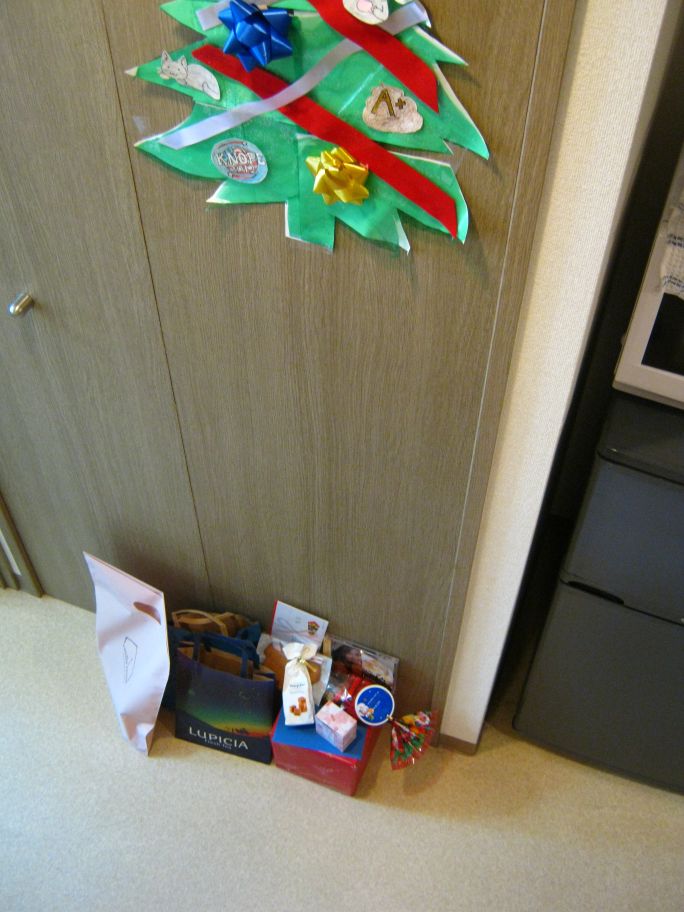
To my friends: Thank you for the "quality" "handcrafted" Christmas tree and ornaments that were a tribute to our year in California together. You guys never fail to brighten my day and make me laugh. I miss spending time with you guys, playing Telephone Pictionary and 1000 Blank White Cards, laughing uproariously at Parks and Recreation (Knope 2012!), making makeshift Japanese cuisine, and going on adventures to San Francisco together. We shall have more adventures together in Japan someday soon! I decree it.
My friends are arts-and-crafts masters.
(The cat with the stubby tail is my dearly-missed Ebenezer.)

And, finally, to my mother: Thank you for everything, especially the praying shawl and the the 3-pound Costco jar of peanut butter. The former is lovely and super cozy and the latter is hilarious and will make me many a sandwich in the months to come.
Guess which one is from America.

God's blessings to you all! Your generosity is much appreciated. Merry Christmas!

The grace of the Lord Jesus Christ be with your spirit. Amen.
Philippians 4:23 (NIV)

Tuesday, December 11, 2012

Japanese class.

All the new Japan missionaries have been taking a Japanese class courtesy of the Japan Evangelical Lutheran Association, but since I've already studied it I get individual tutoring twice a week. Every session starts with a reading from Yohane ni Yoru Fukuinsho, the Gospel According to John, in my new copy of the Shin'yaku Seisho, the New Testament.

Cutest New Testament ever?
These are stories I've grown up reading and hearing, but somehow reading and discussing it with my teachers in a different language than English puts everything in a new light. The Wedding at Cana, where Jesus changes water into wine for example--once in high school or college I heard a speaker say "Jesus' first miracle was to keep the party going," and he thus affirmed human fellowship and celebration--and good wine. It was a sentiment I held on to for years. But when I was discussing the story of the Kana de no Konrei with Morikawa-sensei, he explained, in Japanese, how he saw the miracle of the wine--the good wine--as foreshadowing the saving blood Jesus would later shed at the Cross. I'd never made that connection before. And then I noticed that the jars were for ritual purification (kiyome)--more symbolism! The Japanese Bible also takes pronounciations and place names from the original Greek and Hebrew, so some of the names and locations are unrecognizable at first glance--Kaferunaumu is Capernaum, Petoro is Peter. It's a gift. The words are no longer just a chant I've long been desensitized to.

Then after a break, we crack open my brand new Japanese textbook. It's intermediate-level, something I originally thought would be too easy for me. (This was before I was humbled by my rice cooker.) But what I neglected to notice when Morikawa-sensei picked out the book for me at Kinokuniya was that this thing is entirely in Japanese, with no precious glossary or translations to help me, either. After I stumble through a short essay and verbally answer questions about it, we go over grammar points and new expressions. Homework is leftover questions (more when I have a particularly "slow" day) or a weekly essay... which I have the bad habit of starting at 8pm the night before it's due. College all over again.

Essay on Thanksgiving, corrected by
Morikawa-sensei.
Morikawa-sensei and Narabu-sensei have been really great teachers, and I'm grateful to them for taking two hours out of their week to listen to an American girl stumble through the story of the Feeding of the 5,000 and a short essay on world food customs, and then teach her the appropriate use of the "(verb)-to (verb phrase)-yōde (adjective)-naru" construction. Narabu-sensei even prints out pages from guidebooks and gives me suggestions on where to go in Tokyo on my free time along with some insider info. (Did you know the founder of Panasonic donated the giant lantern at Kaminari-Mon ["Thunder Gate"] at Sensō Temple in Asakusa? His name is on the bottom of the lantern.) I really do love being a student... but the last class is this Friday and in a few short months I'll be a teacher myself. I hope I can have half the patience and positivity of my Japanese teachers here in Tokyo.

All Scripture is God-breathed and is useful for teaching, rebuking, correcting and training in righteousness, so that the servant of God may be thoroughly equipped for every good work.
2 Timothy 3:16-17 (NIV)

Sunday, December 2, 2012

Food.

It's been just a little more than a month since I arrived in Tokyo and I think I've established something of a routine. Sunday is church, Tuesday and Friday are Japanese class, Wednesday is study hall while the others are in Japanese class (I do one-on-one tutoring), and the rest of the time is... well, maybe I don't have a routine after all. In my free time I've cleaned my apartment, done my homework, cooked one-person meals or gone grocery shopping. I've also discovered cheap (and not so cheap) restaurants around my apartment... and I've eaten at the 24-hour McDonald's down the street more than I'd like to admit.

When I want to save money (and don't want to make the twenty-five-minute trek to the only cheap udon noodle place in the vicinity that I know), I usually subsist on peanut-butter-and-jelly sandwiches, Kōn Furēku Shugā Taipu ("Corn Flake Sugar Type," the cheap store-brand equivalent of Frosted Flakes), bananas, hard-boiled eggs, rice, and miso soup (with tofu, if I remember to pick some up!). For dinner, it's either spaghetti or yakisoba, the stir-fried noodles you may recall me raving about in my entry on Hongo Bible Camp.

Ridiculously proud of this.
Yakisoba was the first meal I ever cooked here. Though not nearly as good as what they serve in restaurants (the noodles come prepackaged with a separate seasoning packet--much like instant ramen), it's still easy to make and filling enough to make a decent dinner much cheaper than any restaurant in Tokyo (including the McDonald's!). Throw in a quarter-head of cabbage for 38 yen and you get a cheap serving of vegetables, too! (Well, stir-fried, but that still counts, right?)

To make miso soup you need 22.5 SPOON of miso.
When I finally decided to look for a real recipe (as opposed to the instructions on the back of the package), I discovered that my apartment actually lacks a set of measuring spoons. I needed them to make miso soup, so when I found them at our local (tiny) grocery store, I threw them into my basket without a second thought. Japanese recipes use ōsaji ("big spoon" or tablespoon) and kosaji ("little spoon" or teaspoon), so I figured they wouldn't be too different from what I used in the States.

But then I got home and untied them from the card they were on, I discovered that they were labeled in the most cryptic way possible. The biggest spoon was "15 SPOON," then "5 SPOON," "2.5 SPOON," and "1 SPOON." The back of the package was no help--just a wall of Japanese. It was only after some Googling and deduction that I realized the numbers were milliliter measurements. Did you know a tablespoon is 15 mL? Now I do.

It means "0 hours since the rice was done"
but I still like thinking it's startled.
I had another little victory when I figured out how to use my rice cooker... with a little help. Six years of Japanese language study may have allowed me to be able to articulate the homeless problem in Osaka or talk about the importance of eating together with family at mealtimes, but I still had to Google how to work the thing. (Turns out it's essentially "plug it in and push the giant red button.")

So there's a glimpse of my daily life here. In future entries I'll talk about my Japanese class, my church, lectures I've attended, English classes, and even more reflections on my life in Tokyo. For now, though, I'm gonna soak some rice and make me a PB&J.

A person can do nothing better than to eat and drink and find satisfaction in their own toil. This too, I see, is from the hand of God, for without him, who can eat or find enjoyment?
Ecclesiastes 2:24-25 (NIV)