Wednesday, October 16, 2013

A day out: Mount Kinpō.

As I've learned the past six months, the life of a J-3 is busy. On Sundays I'm often at church until past 2:00 (and then again till past 7:00 at the International Service), and on weekdays I'm often at school till past 6:00. My Saturdays are technically my free day but they're often filled with church or school events. I enjoy it--I really do--but it means that I do things like post blog accounts of my summer vacation two months after the fact.

But one nice thing about Japan: they love their national holidays. There's nary a month when I don't have at least one Monday off for things like "Respect for the Aged Day" or "Culture Day" or "Marine Day." Monday was "Health and Sports Day," and I spent it climbing a mountain with my pastor, two of his kids, and a member of my church, Mr. Nakamura.*

Mr. Nakamura is the "principal" of the Kuwamizu Sunday school and also the spryest 71-year-old I've ever met. He also often sits next to me in church and is one of the most enthusiastic members of the newly-formed 5-to-7-member (depending on the Sunday) church choir. "Next Monday," he told me last week after choir practice in his limited English, "Let's climb Mount Kinpō!" He mimed hiking vigorously and told me he loved mountain climbing.

I was hesitant at first (I'm terrible at hiking up mountains; see this year's Golden Week entry about climbing Kishima-dake in Aso with Caroline), but our climbing party would also include an 8-year-old, so I figured it wouldn't be too hard. Plus I do enjoy spending time with members of my church.

We got on a bus at the city's main terminal and rode through the old part of town, then out to the mountains where everything was green and fresh. (I love that Kumamoto City's a place where it only takes a 15-minute bus ride to be in the middle of nature... can't do that in Tokyo!) We disembarked at a rural little crossing with a few houses, shops, and vegetable stands, where Mr. Nakamura bought some mugwort-flavored rice cake dumplings filled with sweet red bean paste. Treats for when we finally got up the mountain.

Mt. Kinpō from the bus stop.
Mr. Nakamura came out of the shop and pointed to a distant verdant mountain topped with broadcast towers. "There it is!" he said. My jaw dropped. All the way up there? Pastor Sumimoto laughed and asked if I was going to be all right. "I'll do my best," I said meekly, prompting more good-natured laughs. "If at any point you're having trouble, let us know," said Pastor Sumimoto.

We walked along a street that ran steeply uphill, reflecting on how quiet and peaceful it was and how nice it would be to live there, except for the giant spiders who had webs every five feet or so. Many houses had large yards (a rarity in Japan!) that had pear orchards and big vegetable gardens. Some set up unmanned makeshift fruit stands with pears and potatoes for sale, and a little open tin to collect the money. Honor system. I quietly lamented the fact that there was no way that would fly in America and made a mental note to purchase something on my way back down.

Finally we got to a little rest area near a forested shrine gate. "Koko wa start point!" declared Mr. Nakamura. Start point? I was already winded by the street hike!

Start point.

The two kids (boys, ages 8 and 13) ran ahead, and Mr. Nakamura and Pastor Sumimoto kept a good pace, but I brought up the rear, breathing heavily. The steep slope, log steps, and fallen leaves made me thing of some of the more strenuous hikes back at my old summer camp. If I could hike to the highest point of Westminster Woods with a bunch of middle schoolers, I could hike up a mountain in Kyushu.

View from a resting place halfway up.
Our rest breaks became more frequent, but Mr. Nakamura would always look at me and go, "Mō sukoshi dakara!" with an encouraging smile. "Just a little further!" Then we turned to start up the steepest staircase yet when a couple of hikers came down and told us the peak was at the top of those stairs.

And there it was. The top of the mountain. There were probably twenty or thirty people up there already, enjoying their picnic lunches. So we settled in to enjoy our own. I hadn't had time to get a lunch beforehand, but Mr. Nakamura had me covered. He handed me a bottle of green tea and standard Japanese snack fare: two onigiri rice balls. One was filled with kishū ume, pickled plum paste, and one with karashi mentaiko, spicy marinated fish eggs. Both were delicious, though pickled plum is my favorite.

Then it was obligatory picture-taking time before we headed back down the mountain. If there's one thing Japan has in abundance, it's good views.

Toward the ocean. To the left is the mouth of the Shirakawa River that
runs through Kumamoto City. Straight ahead (hidden by the haze) is Shimabara, site
of the 1637-38 Shimabara Rebellion. More about the Shimabara Rebellion here.

The journey down was much easier than the journey up, and took probably only a little over half the time. Finally, we reached the quiet street that led back down to the bus stop. Along the way, we nearly bought out this tiny fruit stand:

Akebia fruit and Asian pears, 300 yen (about $3) for a bundle or a bag.

I put my newly-purchased Asian pears in my backpack as we continued back toward the bus stop. "Have you ever heard of akebia?" Mr. Nakamura asked, handing me a hollow, rough, brownish-red fruit. I said no. Pastor Sumimoto added that many Japanese didn't know what it was, either. I looked it up in my phone's dictionary to find its English name was "chocolate vine," to our collective bewilderment. "Like chocolate grapevine?" asked Pastor Sumimoto. We puzzled over the etymology until we reached our destination, two shady benches across from the stop where our bus wouldn't arrive for another 20 minutes. Mr. Nakamura and I sat on a bench and talked about Japanese history while Pastor Sumimoto and his kids relaxed on another one. "America seemed like the best country when I was a kid," Mr. Nakamura told me. "Everyone wanted to go there because it was so rich while Japan was so poor." I looked around at the freshly paved roads and watched shiny new cars whoosh by modern houses. A few weeks ago over Sunday lunch, Mr. Nakamura handed me a piece of chocolate and told me about how during the Allied occupation of Japan, an American soldier gave him chocolate and he thought it was the greatest thing he'd ever tasted. Japan's come a long way in the past 65 years. And yet, there's a spiritual poverty, too, as evidenced in the country's high suicide rate and the fact that in terms of satisfaction with life Japan ranks extraordinarily low, especially for a developed country. It's a unique mission field.

As our bus rolled into town, Pastor Sumimoto, who was sitting next to me, remarked, "It was good to spend a holiday surrounded by so much nature, wasn't it?" It was, indeed. Arigatou gozaimasu, Mr. Nakamura.

The climbing party: from left to right, Mr. Nakamura, the 12-year-old, the 8-year-old, and Pastor Sumimoto.

*Names have been changed.

Your love, Lord, reaches to the heavens,
your faithfulness to the skies.
Your righteousness is like the highest mountains,
your justice like the great deep.
You, Lord, preserve both people and animals.
How priceless is your unfailing love, O God!
People take refuge in the shadow of your wings.
They feast on the abundance of your house;
you give them drink from your river of delights.
For with you is the fountain of life;
in your light we see light.

Psalm 36:5-9 (NIV)

Monday, October 7, 2013

Summer travels.

Between regular classes, extra classes, extracurriculars, sports, and other events, Luther is open most of the year, but there are a couple of occasions when it closes completely. Obon, the annual late-summer Buddhist commemoration of the dead, is one of those times. During Obon, most Japanese people return to their hometowns to clean their family gravesite and pay respects to their ancestors, whose spirits are said to revisit the household altar every year. Many Obon customs are rooted in guiding spirits back home. Obon is also peak travel season, but Caroline and I decided to brave the crowds and make our way back to Tokyo for a few days and then up to northern Honshu to visit some less frequented parts of Japan (and beat the brutal Kumamoto heat). Armed with a special train ticket that allowed us cheap travel on local trains around the country, we stuffed all our supplies into our smallest carry-on suitcases and flew into Tokyo on a budget flight on August 7 to start our journey.

Erik and Tauna, the missionary couple in Tokyo that came to Japan at the same time we did, graciously hosted us as we reunited with old friends from Hongo Student Center and our respective Tokyo churches that we have been missing dearly. It was good to see everyone again, enjoy delicious meals, and hear what's new in that crazy old metropolis. We also had the chance to check off a couple tourist activities we didn't get to when we lived in Tokyo last year:

Number one was a rickshaw ride through Asakusa. (Tokyo Skytree in the background.)

Number two was Tokyo DisneySea, the neighboring Disney park to Tokyo Disneyland.

Then it was on to the north. After ten hours on and off local trains, we arrived in the rural city of Yamagata. After a good night's sleep we woke up the next morning and took a scenic train journey to the temple complex of Yamadera, built into a mountainside.

Bashō and Sora. Photo by Caroline.
Unbeknownst to me at the time, we were (sort of) following part of the path the famous Japanese haiku poet Matsuo Bashō took as documented in his 1689 travel journal The Narrow Road to the Deep North, a book I read (and greatly enjoyed) years ago for a college class. I didn't realize it until we passed commemorative statues of him and his traveling companion Kawai Sora on our way up the mountain. We sweated and climbed up and down countless stairs, and I had to stop and drink water after every flight, but the views were breathtaking.


Bashō wrote of Yamadera almost 450 years ago, but little has changed since then:

Boulders piled on boulders had created this mountain, and the pines and cedars on its slopes were old... Circling around the cliffs and crawling over the rocks, we reached the main temple building. In the splendor of the scene and the silence I felt a wonderful peace penetrate my heart.
Matsuo Bashō, trans. Donald Keene, The Narrow Road to Oku (Kodansha, 1996) 99.

Then we headed up to Matsushima, a bay dotted with hundreds of little pine-covered islands, renowned for being one of the "Three Views of Japan." We took an hour-long "Bashō Cruise." Once again, Bashō is much better at describing things than I am:


There are countless islands. Some rise up and point to the sky; the low-lying ones crawl into the waves. There are island piled double or even stacked three high... Some look as if they carried little islands on their backs, others as if they held the islands in their arms, evoking a mother's love of her children. The green of the pines is of a wonderful darkness, and their branches are constantly bent by winds from the sea, so that their crookedness seems to belong to the nature of the trees... What man could capture in a painting or a poem the wonder of this masterpiece of nature?
Matsuo Bashō, trans. Donald Keene, The Narrow Road to Oku (Kodansha, 1996) 79.

After Matsushima we deviated from Bashō's path and journeyed to the historical samurai town of Aizu-Wakamatsu, our last stop on our trip. Unfortunately, we missed our train, so the journey took a lot longer than we expected, and by the time we stumbled into our ryokan, a traditional Japanese inn, I was suffering from heat exhaustion pretty badly. Thankfully the very hospitable staff let us check in early so I could rest in the room while Caroline went out and explored the town. I gotta say, if you have to have heat exhaustion, a ryokan's not a half-bad place to recover from it.

Exterior of the ryokan. (Photo by Caroline.)

Our room. On the table are the remains of the next morning's breakfast.

Sitting area in our room, facing the garden.

Yukata at a festival--a Japanese summer tradition.
After a bath and delicious local-specialty dinner of fish (both cooked and raw), vegetables, pickles, rice, soup, and tomato jelly for dessert, I felt much better and Caroline and I ventured out in our ryokan-issued yukata (light summer kimono) to see the Bon odori, or Obon dance, going on right in front of the river. A singer and instrumentalists stood on a platform over the river while a procession of people young and old, yukata- and Western-clad, Japanese and foreigner, slowly made their way around the platform, crossing bridges over the river and moving their arms in time with the beat.

Performers on the platform over the river.
(The banner says the festival is sponsored by the local newspaper.)

Here's a short video I took of the dance procession:


When we got back inside, our futon beds were already laid out on the tatami-mat floor for us. So we settled in for our last vacation night, happy but exhausted. It was a great ten days, though we both learned quite a few hard lessons about traveling. (Plan a rest day! Always plan a rest day! Also, count the number of clean pairs of underwear in your suitcase before you hop in the shower.) It was a wonderful opportunity to experience some other parts of Japan, but it also was nice to return to Kumamoto and get back into the swing of things at church and school. An Obon well-spent, I think.

The Lord will watch over your coming and going both now and forevermore.
Psalm 121:8 (NIV)

Friday, September 20, 2013

Church in Japan.

Despite over 450 years of contact with Christianity, Japan is less than 1% Christian. For whatever reason, Christianity hasn't really stuck. I've talked about in previous posts about Christmas being seen as a romantic couple's holiday and Japan's long history of persecution of Christians until 140 years ago. The modern Japanese church is small but determined, though--and quite close-knit. (When your numbers are so few, you can't really afford major schisms.)

I work for the Japan Evangelical Lutheran Church, one of the two major Lutheran denominations here. The JELC has 22,000 baptized members spread across 238 churches around the country. The typical church is quite small, and its members skew toward the older end of the age spectrum, a result of the Japanese church's small revival immediately following World War II. (At a national Lutheran teens' camp Morgan, Caroline, and I were invited to in March, there were 94 kids in attendance. My little summer camp back in Northern California has had more teens for a single week of high school camp than there were 12-to-18-year-olds at this national gathering, which was held at a little retreat center in Aso. Compare the ELCA Youth Gathering, which last year saw 33,000 teens fill the Superdome in New Orleans.)

Entrance to Kuwamizu Church (behind the tree). Yes, that's a Shintō
torī gate at the front--there's a shrine further down the street. The church
jokes that one of these days a cross should be engraved on the torī, too.
There are five JELC churches in Kumamoto City, and four are currently served by J-3s. I am assigned to Kuwamizu Lutheran Church, founded in 1932. It's a small church, but very active. Kuwamizu is also connected to The Colony of Love and Mercy, the first welfare organization in Kumamoto. Founded in 1919 by American Lutheran missionary Maud Powlas, it has several homes for orphaned and abused babies and children, developmentally disabled adults, and the elderly, as well as a kindergarten.

Most of my work is based in the church itself. I attend morning worship every Sunday, and once a month hold an English Bible Study after the service. I also help out with Sunday School in the mornings, where the teachers sometimes have the kids practice their English with me. (The most common questions are "How old are you?", "How tall are you?", and "Do you have a boyfriend?" I find all three very amusing, and always answer honestly, except the third one. "It's a secret," I always tell them.)

Recent charity concert in the Kuwamizu sactuary.
Japanese Lutheran church services are pretty much the same as "old-school Lutheran services in America," according to the born-and-raised Lutheran Caroline. We follow the same order of worship every Sunday with the same "Gloria," "Kyrie," "Agnus Dei," and "Nunc Dimittis" refrains. Oh, and we always sing a few verses of Psalm 51 as the plate gets passed. I've also yet to encounter a Lutheran church without a pipe organ here. We sing hymns out of a churchwide hymnal made up of traditional European and American hymns (translated into Japanese) mixed with some Japanese compositions. (Praise bands and worship teams haven't really caught on in Japanese Lutheranism, though the pastor of Tokyo Lutheran himself heads up a rock band. There's a video here, and I highly recommend you check it out. Sekino-sensei rocks out in his vestments.)

Sanctuary of Kumamoto Lutheran Church.
One other important church event in town I'm involved with: the International English Service, every Sunday at 6pm at Kumamoto Lutheran Church. (If you're in town, stop on by! It's the little church on Sangōsen at the Suidōchō intersection, around the corner from the Daily Yamazaki.) We minister to the Christian (and sometimes non-Christian) English-speaking population of Kumamoto. I occasionally lead the service (though we usually leave the sermons to a local missionary pastor), but Katie and I also run a children's program before the service twice a month. It's a good way to get to know some of the missionary and English-speaking kids in town. They're a lot of fun. (And surprisingly good at Twister.)

It truly is a joy to serve the Japanese church, though much of the time I feel like I'm receiving much more than I'm giving. (The hospitality of church members here continues to floor me.) Please pray for this small but dedicated group of brothers and sisters in Christ as they live out the Gospel in an increasingly secular society.

This is a trustworthy saying that deserves full acceptance (and for this we labor and strive), that we have put our hope in the living God, who is the Savior of all men, and especially those who believe.
1 Timothy 4:9-10 (NIV)

Thursday, August 22, 2013

English Summer Camp and missionary reflections.

Roasting marshmallows on bamboo sticks,
because we're still in Japan.
At the end of July, Luther held its annual English Summer Camp. 77 students, 4 Japanese teachers, and 8 counselors (including Caroline and me) spent two days and two nights at a camp in the mountains playing games, making pizza, and speaking English. It was still warm and humid there, but the nights were deliciously cool. The dampness also allowed us to build a campfire right on the lawn! (The downside was that if we weren't quick, the air also made our s'mores soggy.) It was a good time.

It was also an example of one of my struggles as a missionary English teacher in Japan. After three summers as a staffer at a Christian summer camp back in the States, I associate camp with deepened faith and spiritual experiences. English Summer Camp was tons of fun, but the spiritual aspect I'm so used to was pretty much limited to prayers before meals.

Luther's chapel.
While 87 years ago Luther started as a missionary school, nowadays less than half the staff and only 3-4% of students are actually Christian. Outwardly, most of Luther's Lutheranism is only expressed in the presence of a school chaplain, mandatory daily chapel, and four American missionary English teachers. (Conversations with other teachers often amusingly go like this: "So how was your weekend? Oh, right, you had church on Sunday, of course.") And while the J-3s deliver chapel speeches regularly, and give Bibles to the kids preparing to study abroad... I'm gonna be honest. Deep spiritual conversations are not a usual part of my daily routine here. It's more like, "A rough draft is the first time you write a paragraph," or "Kōtarō*, wake up," or "Everyone, please repeat: Can you tell me how to get to the post office?" or "Kōtarō, move your desk back to where it was and sit down."

Bust of a suffering Christ outside
the top-floor English classroom.
It of course sparks many feelings of anxiety and inadequacy as a missionary. Shouldn't I end the semester with some kind of altar call or something instead of a fun movie lesson? Shouldn't I try to work in at least one Jesus reference in class? (I tried that in one of my junior high classes during a listening comprehension activity. It ended up sounding awkward and forced. I think I was jumping the gun instead of waiting for the Holy Spirit on that one.)

Sometimes I wonder if God's doing anything with me at all. I get really wrapped up in results. I like getting handed back a paper with a score on it. I can work with that. I can know if I'm "good enough." But the work of the Holy Spirit isn't about being "good enough." It's not predictable, quantifiable, or often even visible. This coming semester, I think I'll focus less on production and output, more on prayer and quiet trust. Thy way, not mine, O Lord.

Fireworks at camp! (There is no electric light in this photo, not even camera flash. All fireworks.)

*Names have been changed.

In the same way, the Spirit helps us in our weakness. We do not know what we ought to pray for, but the Spirit himself intercedes for us through wordless groans. And he who searches our hearts knows the mind of the Spirit, because the Spirit intercedes for God’s people in accordance with the will of God.
Romans 8:26-17 (NIV)

Tuesday, July 30, 2013

July highlights.

It's a hard transition from 22 years of hot, dry summer freedom to still reporting to school every weekday at the end of a sweaty, humid July. Ironically, I've only gotten busier since classes properly ended for the summer back on the 12th. (Yes, it's summer vacation, but that term is extremely loose in Japan. School is still open, required extra summer classes are being held, and 18 five-paragraph essay rough drafts ready to be edited are calling my name.) Since then it's been grading, planning for when the real vacation starts, running errands I couldn't do while school was still in session (like going to the post office), Saturday Open Campus at Luther, and other activities. The Big Thing that's been eating up most of my time is preparation for Luther's annual English Summer Camp, which takes place this week. There will be big, long posts later, but for now I can only touch on a few highlights of the past month.

Highlight 1: July 4! (And Caroline's birthday.)
Thanks, Mrs. Caroline's Mom!
Naturally, the Japanese don't have much reason to celebrate America's Independence Day. It was a normal school day, but I snuck in some American pride. Caroline's mom is awesome and sent the three of us (Caroline, Morgan, and me) matching 2013 Old Navy American flag tank tops. After getting approval from Katie, I threw in in a white camisole and cardigan to make it school-appropriate and wore it throughout the day.

Hilariously, most teachers and students didn't notice my patriotic wardrobe. (And when they did, they thought it quite charming.) America-themed clothing is everywhere here in Japan... I'm talking stars-and-stripes, outlines-of-the-continental-United-States, "I ♥ AMERICA" t-shirts--pretty much just a fashion statement, not an actual declaration of love for or loyalty to the United States. We blended right in that night as we went out for Korean barbeque. (It's the closest thing to a real American barbecue we can get at 8pm on a school night.)

Low shutter speed makes for cool shots...
and blurry Carolines.
Of course, no July 4 is complete without fireworks, and they are gloriously legal here. So after a safety lecture ("It actually says on the bag specifically not to light it the way you're about to light it, guys!"), we went out on Caroline's veranda and rang in the Fourth the way it was meant to be.

Two days later, Caroline celebrated her first quarter-century. We went out with some friends from the weekly Sunday evening English church service and celebrated in the Japanese fashion... with karaoke and photo booth shots. (Japanese photo booths are called purikura--they're crazy high-tech, in every shopping mall and arcade, and usually filled with schoolgirls making kissy faces and peace signs at the camera.)

We turned the "doe eyes" setting all the way up. It had an... interesting effect on the guys.

Highlight 2: Guitar!
Some of you know how disappointed I was to have to leave my accordion back in the States, but recently I inherited another musical instrument. This one's a little more conventional, and a lot more lightweight.
 
A legacy from past J-3s.

I've only been playing for three weeks, so my fingers are still getting calluses and it takes me five to ten seconds to change between the three chords I know, but I'm working on it!

Highlight 3: Kittens!
There's a litter outside our apartment building. They make my returns home a little more adorable.

Mom was giving them baths before I startled them.

In August things should slow down a bit... maybe. There are many more posts I want to write and stories I want to share, but there's an equal amount of stuff I have to grade, chores I have to do, and sleep I desperately need. In the midst of this busyness, it's hard not to stress out. But, as the story of Mary and Martha (this past Sunday's Gospel reading) reminded me, I need to step back, take a breath and remember why I'm here. (Hint: It's not just to teach kids how to write a thesis statement.)

"Martha, Martha," the Lord answered, "you are worried and upset about many things, but few things are needed—or indeed only one. Mary has chosen what is better, and it will not be taken away from her."
Luke 1:41-42 (NIV)

Sunday, June 30, 2013

School in Japan.

What you're about to read started out as a bulleted list in Notepad several months ago and eventually became the wall of text you see before you. I'm thinking in the future I'll switch to a more vignette style in my blog entries, and thus (hopefully) be able to post more often. But hopefully this will give you some background on what my work environment during the week is like.

Luther High School, established 1926.
The Japanese school system is incredibly different from America in almost every way. To start, it's year-round, so it ends in March and begins in April. Elementary, middle, and high school last six years, three years, and three years, respectively. This applies nationwide, even to private schools. And grade levels aren't K-12. A student in their ninth year of post-kindergarten education wouldn't be in "ninth grade," they'de be in "middle school third year." It took me way too long to realize why people looked so confused when I told them I first came to Japan when I was in "high school fourth year." There is no high school fourth year here.

Students stay with the same classmates all day (their "homeroom"), and in the same classroom, too; it's the teachers who move around. (The only exceptions are classes that require special equipment, like science.) Homerooms' schedules are different on every day of the week. One homeroom I teach has English first hour on Monday, but fifth hour on Wednesday. (The hope is that they will be more alert at one of those times. The consequence is that it's been three months and I still don't have my weekly schedule completely memorized.) Each homeroom is made up of about forty kids and has an assigned homeroom teacher that's almost like a third parent in how much responsibility they take for their students. They do a lot of disciplining and counseling, and also spend long hours on the phone with parents.

My sweet ride, a standard Japanese commuter bike (foreground).
Japanese students in general are much less independent than their American counterparts. Forget driving to high school; you can't get a license here until you're 18. Plus the parking lots are tiny and many people commute to work and school on bicycles anyway. (I'm one of them!) Japanese students' lives revolve almost entirely around school, with very little spare time. They're often at school on weekends and/or before the crack of dawn and/or long after it gets dark for club activities, sports practice, required extra classes, or discipline. (One girl in my junior high class got into trouble and now has to help clean campus every morning for a while.) Every junior high and high school, public or private, requires its students to wear uniforms not just in school but when they're in public, too. This technically includes weekends and vacation. Every school's uniform is distinct, so if a student misbehaves in public, everyone knows which school to call for discipline (usually dealt by the homeroom teacher). Luther even has embroidered uniform socks and uniform book bags.

Speaking of which, the dress code at Luther would make most American high school students squirm. Students are not allowed to wear piercings, makeup, nail polish, or colored contact lenses, and if girls' hair is longer than shoulder-length they have to tie it up. (Boys aren't allowed to grow it out that long.) Students are also not allowed to dye their hair. If they dye their hair they must go to a salon and get it dyed back to black. (They're also supposed to save the receipt and submit it to the school to prove that they didn't just apply temporary spray-on dye.) If students actually, genetically, have lighter hair, they have to submit documentation of their family history for it. In addition, students aren't allowed to pluck their eyebrows, shave their heads, or grow their nails too long. Boys can't have facial hair, either.

Sometimes the girls will try to sneak in makeup or colored contacts, or shorten their skirts (they're supposed to fall low enough that the hem touches the floor if the girls kneel) by tying them up with long elastic strings under their shirts. It's usually pretty easy to spot which girls have done this. In a delicious cycle, Katie confiscates the strings and then cuts them up to make hair ties to hand out to the girls whose hair isn't tied back.

View from my desk in the teachers' office.
The social structure of a Japanese school is much more vertical than in the States. I was having lunch with one teacher the other day who had gone to the same high school and college as his friend, another Luther teacher, who was a grade level above him. "Were you two friends in high school, too?" I asked. He seemed surprised, and then replied, "Not friends. He was my senior." Students are very attached to their homerooms and peers in the same grade--so much so that their juniors use a title--senpai--instead of their actual name to address them, even if they are friends. And the teachers are ranked even higher. When students enter the teachers' office, they must recite their name, grade level, homeroom number, and attendance number before announcing which teacher they are there to see. Then they have to ask, in the most polite Japanese possible, if it might possibly be all right if they entered. Then, as they leave, they always bow and say a formal apology that in practice is used for "goodbye." This form is all printed on a laminated placard on the door so the students remember, right under a chart that shows which teachers are at which desks.

Ministry-approved junior high English textbook
that made me a little homesick.
As for the curriculum, there's no control at the prefectural or local level, public or private; it's all managed by the Japanese Ministry of Education. With a few special excpetions, even private schools have to pick textbooks that are Ministry-approved--a practice not without controversy, especially when it comes to history books. The entire system seems to be made of tests--skill tests, entrance exams, standardized tests, college prep exams, English vocabulary tests, Chinese character tests. Classes are often taught lecture-style and with a focus on rote memorization. Not sure which one came first--the tests or the teaching style. The English classes I team-teach are much more American-style, with more focus on participation and discussion. Sometimes the students warm up to it, but often if a teacher asks a question to the whole class, the students respond with blank stares and a long silence. (Shiiiiiiiiin, in Japanese onomatopoeia.)

30% is considered a passing grade here. I was shocked to learn that when I first arrived, but as I started to teach, I realized that these students are busy as all get-out. It's not that the students aren't doing their best, it's that they don't have time to do their best, with all the clubs and extra classes and fifty kinds of standardized tests they have to study for almost every week. They have barely enough time to even sleep at night. Consequently, students falling asleep in class is the biggest disciplinary problem I encounter. On the plus side, they often don't have enough time to get into trouble in public, either.

Top-floor Dainishichōkakushitsu ("No. 2
Audiovisual Room," or "Heaven" to the
native English teachers) after cleaning.
Another responsibility Japanese students have is cleaning. At Luther there's no custodial staff, aside from an older lady who cleans the entrance and staff bathrooms every morning. There's a dedicated fifteen-minute period every afternoon where small groups of students report to their assigned areas of the school to clean, which is kind of a raw deal for the students who get stuck scrubbing the bathrooms. Other jobs including sweeping the outdoor walkways and cleaning the teachers' office (where they are watched carefully). I'm in charge of one of the two special audiovisual classrooms used for English classes on the top floor, where every afternoon students clean the desks, empty the garbage, and vacuum the carpet, which is generally pretty clean anyway, due to the fact that shoes aren't allowed. (Shoes are not allowed in the library, either. The students generally drop their shoes at the entrance and pad around in their socks, but there are a few pairs of slippers available for teachers and guests.)

This post may have been information overload, but it's reflective of just how different my work environment is from anywhere I've ever been before. It's hard to imagine myself or my classmates from high school in an environment like this, dressed in uniforms and standing and bowing to teachers at the beginning of class. When I was in high school, the only time I was ever regularly at school past 4:00 was the year I took Journalism on nights before the school paper was due--and even then my teacher would order pizza for all of us. (We had a sweet deal with a local pizzeria where we gave them free advertising in exchange for free pizza once a month.) It makes it hard to relate to my students sometimes, except that liking Taylor Swift and Harry Potter seem to be universal.

There are plenty of advantages and disadvantages to the Japanese school system, and with all the structure it's sometimes hard to remember that I'm here primarily as a missionary and not an English teacher... especially when I'm showing students a giant picture of a hamburger and explaining that it's like a paragraph (see, the the two slices of bun are the topic and concluding sentences, and... yeah). But regardless, it's the backdrop against which I do most of my work, and I'm glad I get to see firsthand what these kids go through in their daily lives. I'm hoping and praying for more opportunities to connect with them in and out of class, and really looking forward to the next 21 months here. It's gonna be a a busy, but I think rewarding, next couple of years.

Monthly Luther/KyuGaku English Conversation at a downtown Starbucks.
Luther students in the light blue, KyuGaku students in the gray.
Posted with permission.

Of making many books there is no end, and much study wearies the body.
Ecclesiastes 12:12b (NIV)

Saturday, June 8, 2013

A trip to Aso.

At the end of April and beginning of May are a coincidental cluster of Japanese holidays collectively known as Golden Week, which is a very popular time for Japanese people to travel. This year the J-3s got a three-day weekend and then a four-day weekend. Caroline and I decided to dedicate two of those four days to go exploring the Aso region about a two-hour train ride out of the city. Aso, which, despite its official designation as a "city," is about as rural as you can get here in Japan. Mount Aso itself is a still-active volcano, which means that the area is rich in natural beauty and, my favorite, hot springs. Despite our late start in planning, we managed to book two beds at a little youth hostel not far from Aso Station, and the morning of Friday, May 3, we took our backpacks and boarded a train for our first independent Japanese overnight adventure.

Shopping street near Aso Shrine, decorated
with carp flags for Boys' Day on May 5.
Photo by Caroline.
After exploring, finding our hostel, getting lost, and grabbing lunch, we met up with Katie and her husband, and went exploring the side streets near Aso Shrine. This is where Caroline discovered that she didn't like mitarashi dango (steamed rice dumplings coated with soy sauce syrup on a stick), and where I discovered I liked kinako dango (steamed rice dumplings coated with toasted soy powder on a stick). We also discovered that there are basically no trash cans anywhere. ("What am I gonna do with the stick?")

Then we all went to an onsen (hot spring) together for a pre-dinner soak. Well, not together together. In Japan bathing suits aren't allowed at onsen, and ever since the arrival of missionaries in the 16th century, onsen and bathhouses have always been segregated by gender, so Katie, Caroline, and I went to the women's bath to experience the legendary Aso hot spring water. Soaking in an onsen is always amazingly relaxing, but my favorite thing was watching a grandmother interact with her two grandchildren in the bath. ("Abunai!" ["Danger!"] they'd shout before splashing into their grandmother's arms. Bath time is family time in this country, and it's a beautiful thing.)

Our hostel, run by possibly the sweetest lady in all of Japan.
Katie and her husband had to be back in town that night, so they dropped us off at our hostel, where we settled into our bunks for the night. We shared a room on the women's floor with two very nice ladies, one from Germany on a whirlwind Japan tour and one from Kumamoto with a great command of English. The hostel was an older building, but very clean and well-maintained, and you couldn't beat the price. We were a little worried about the bank of motorcycles that were parked out front that night, but we didn't see any of the motorcycle gang members during our stay.

The next day, we got a quick breakfast at a coffee shop and boarded a bus up into the mountains, having decided to take a hike up Kishima-dake, one of the so-called "Five Peaks of Aso." We had the option to hike up Mount Aso itself, but it's an active volcano that spews out toxic gas, so we decided to play it safe with what looked liked a relatively easy, safe, and hopefully uncrowded excursion. We refilled our water bottles and loaded up on rice cakes and dried peaches at the little bank of gift shops and restaurants at the base of the trail, and set out on our journey.

Kishima-dake, which looked easy from here.

But then throw in 837 of these. (We counted.)

And one of these.

At one point I honestly didn't know if I could make it the rest of the way up the mountain. Caroline's pretty fit and active, but I'm not athletic in the least. Biking to and from school every day has done great things for my health, but going up this steep slope I thought I was going to collapse before we even reached the top. But then...

The signpost marking the peak of Kishima-dake, 1,321 meters up.

I had to sit and drink water and eat peaches and rice cakes for a while, but after a short rest I was ready to go exploring the edge of the crater. The view was amazing. Talk about the glory of Creation. This was a literal mountaintop experience.


The view that made it all worth it.

Mount Aso from the peak of Kishima-dake.

As we walked and marveled at the size of the crater we were circling, Caroline and I decided to commemorate our experience with a video. (The wind was pretty strong, so you can't hear half of what we're saying. I tried to caption it, but it kind of messed with the aspect ratio. Sorry.)


Greetings from the mountaintop!

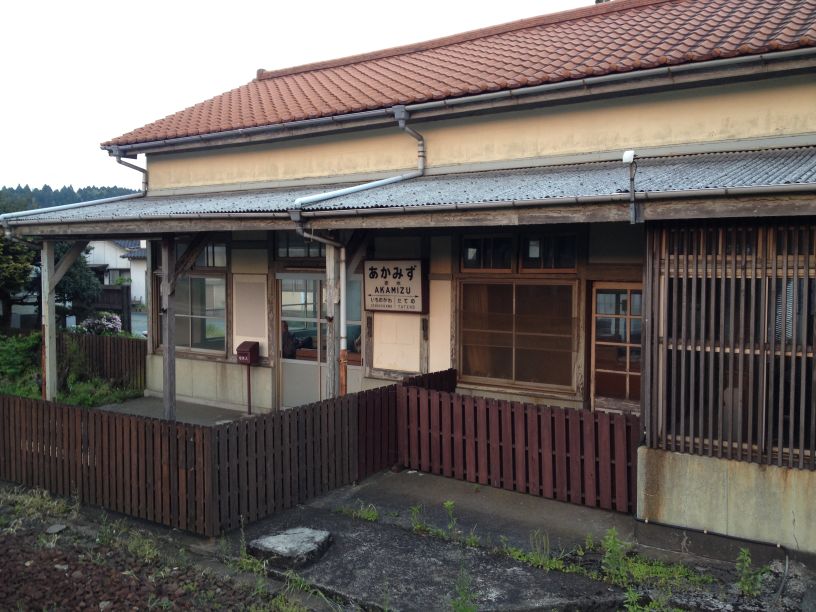
After getting back down from the mountain, we were exhausted, so we took a leisurely late lunch before deciding to go to one more onsen in Akamizu, a couple of stations down the line from Aso. We got into Akamizu Station as the sun set, only to hear that the onsen was closed, and the next train would come forty-five minutes later. Defeated, we plopped into benches on the platform while I whipped out my phone for only the second time all weekend to research any other potential onsen in the area. Then suddenly I heard Caroline say, "Laura. Look up from your phone."


I was completely missing the beauty of that moment. So we didn't get to go to another onsen. We were still given the gift of a gorgeous sunset and great weather. And, as I realized when we boarded our train, I was really tired anyway.

Akamizu Station, site of our non-adventure.

It was an amazing couple of days. As we reflected on how much of a relief it was to get out of the urban environment of Kumamoto City, I was reminded of William Wordsworth's "Lines Composed a Few Miles Above Tintern Abbey," a poem I've had to read several times for various classes in high school and college, where the poet talks about how his memories of the scenic Wye River Valley grant him tranquility "in lonely rooms, and 'mid the din / Of towns and cities":

While here I stand, not only with the sense
Of present pleasure, but with pleasing thoughts
That in this moment there is life and food
For future years.


We've already got plans to go back and visit the parts of the city we never got to. But we have plenty of good memories to sustain us until then.

May the glory of the Lord endure forever;
may the Lord rejoice in his works—
he who looks at the earth, and it trembles,
who touches the mountains, and they smoke.

Psalm 104:31-32 (NIV)

Monday, May 27, 2013

Spring summary.

Things are really heating up around here, both figuratively and literally. Definitely literally. Temperatures have gotten up to almost 90°F (32°C) lately. For now it's just been a dry heat, but rainy season and then the legendarily humid Kumamoto summer are just around the corner. How will a born-and-raised Californian girl handle the subtropical heat? Stay tuned to find out.

Moving day.
On March 25 I moved out of my temporary apartment and into my official J-3 lodgings. Compared to the extended-stay hotel kind of places I'd been in for five months, this apartment is palatial. It's on a bit of a busy street but the neighborhood is nice and there's a couple of lovely parks in the alley out back. All in all I'm just glad to be living in a place with a full kitchen and more than two chairs. One of these days I'm going to host some kind of gathering or movie night here. I can seat six or seven people now! And I can cook for them!

Our hanami view.
On March 27 Caroline, Morgan, and I decided to break in our new apartments with a hanami, or flower-viewing picnic, in one of the nearby parks. It's an annual tradition in Japan that families, friends, and coworkers will gather under blooming cherry trees and have a meal and drinks amongst the falling petals. I tried my hand at making hotteok, those Korean pancakes made of deliciousness, but it just wasn't the same as the ones from the Tokyo street vendors. Oh well. It was a nice afternoon, anyway.

I also had the chance to pay a visit to Kumamoto Castle on March 30, surrounded (naturally) by blooming cherry trees. The view from the top of the donjon is just spectacular. I appreciate that Kumamoto is a city where you can find just about anything but you can also see that nature is just a short distance away.

The donjon, framed by cherry trees.

View toward our apartments and Luther from the top of Kumamoto Castle.

Inside Kumamoto Castle.

On April 1 it was time to don a business suit for my first day of teaching English at Luther. Well, really it was my first day of staff entrance ceremonies and teacher meetings. But then a few more entrance and opening and welcoming ceremonies later (Japanese schools are waaay more formal than American ones), my teaching work really started. I teach about 200 students total (most of them high school first-years) and I have a Japanese partner teacher in every class. I enjoy it immensely, though it's quite exhausting.

On the way into the park.
Some of my favorite students are my junior-high second-years. In American terms, they'd be in eighth grade, and thus probably total punks, but in Japan they're still cute. I got to accompany them to a welcome event on April 26 at a park across town. We all boarded a train together, and then walked the rest of the way in a line. Katie and I brought up the rear.


Jump rope with the first-years.
Up until then I'd only seen the kids in their classroom wearing their formal suit-and-tie or sailor-outfit school uniforms and doing homework. But in their t-shirts and jeans, hanging out with their classmates at a park, it was much more like camp. I got to bond with some of my second-year girls over games of tag (I was instantly declared to be the oni, or It) and Screaming Toes, a camp game I was thrilled to be able to teach them in my halting Japanese. Bonds were forged that day. I'm going to love working with my junior high kids.

Another recent event was Sports Day on May 11, which is a much bigger deal in Japanese schools than in American ones. The entire school came out, even in the drizzly weather, and performed various exercises, races, and stunts. All of the high school boys did crazy gymnastic formations, concluding with human pyramids consisting of all the boys in each class year. It was fun to watch.

Left to right: yellow team, red team, purple team.

Second-year girls' Maypole dance.

Third-year boys doing gymnastic formations.

Third- and second-year human pyramids.

To keep the 1500-meter race entertaining, some of
the soccer (or maybe baseball?) players ran each lap in
a different costume. Here one is as Santa.

Purple team's ōendan. Literally "cheer squad," but much more
intimidating in practice. Check out their hakama outfits!

That about covers the major events up till now, I think. As you probably have guessed, my Internet access has thankfully, finally, been restored. My spare time, however... I don't think I'm going to see that again for a while. I do love my job, even with its six-day work weeks (school on weekdays, church on Sunday) and frequency of being at school past 6:00 in the evening. But the spring-themed stationery I bought purely to write letters to people just sits on my desk long after the real cherry blossoms outside have all disappeared. I still have a pile of emails to reply to, dating back to February. I'm planning to tackle those this week, but we'll see how school goes.

A couple of random fun notes before wrapping this up: on March 16, we made the local news. Apparently the criteria for being selected to march at the front of a St. Patrick's Day parade in Kumamoto are (1) wearing green, (2) looking sufficiently non-Japanese, and (3) standing outside a 7-11 near where the parade begins.

J-3s on parade... and on the evening news.

Also, on April 21 we were treated to basashi, the raw horse meat that Kumamoto is famous for, courtesy of a local pastor. Should I feel guilty that it's delicious? (It's delicious.) But it's also raw meat, and on top of that, raw horse meat, so I can only eat so much at a time before my brain stops me from consuming any more.

Basashi.

I'm really looking forward to the next two years in this city. Yes, there are bad days, and sometimes the weather or the pollution (it blows over here from China, and it is brutal) is extremely unfriendly. But I work with some amazing people, and some amazing students, too. In future posts I'll talk about school, church, and Caroline's and my recent trip to the nearby mountains of Aso. But for now, dinner. 

That everyone may eat and drink, and find satisfaction in all their toil—this is the gift of God.
Ecclesiastes 3:13 (NIV)