Monday, May 27, 2013

Spring summary.

Things are really heating up around here, both figuratively and literally. Definitely literally. Temperatures have gotten up to almost 90°F (32°C) lately. For now it's just been a dry heat, but rainy season and then the legendarily humid Kumamoto summer are just around the corner. How will a born-and-raised Californian girl handle the subtropical heat? Stay tuned to find out.

Moving day.
On March 25 I moved out of my temporary apartment and into my official J-3 lodgings. Compared to the extended-stay hotel kind of places I'd been in for five months, this apartment is palatial. It's on a bit of a busy street but the neighborhood is nice and there's a couple of lovely parks in the alley out back. All in all I'm just glad to be living in a place with a full kitchen and more than two chairs. One of these days I'm going to host some kind of gathering or movie night here. I can seat six or seven people now! And I can cook for them!

Our hanami view.
On March 27 Caroline, Morgan, and I decided to break in our new apartments with a hanami, or flower-viewing picnic, in one of the nearby parks. It's an annual tradition in Japan that families, friends, and coworkers will gather under blooming cherry trees and have a meal and drinks amongst the falling petals. I tried my hand at making hotteok, those Korean pancakes made of deliciousness, but it just wasn't the same as the ones from the Tokyo street vendors. Oh well. It was a nice afternoon, anyway.

I also had the chance to pay a visit to Kumamoto Castle on March 30, surrounded (naturally) by blooming cherry trees. The view from the top of the donjon is just spectacular. I appreciate that Kumamoto is a city where you can find just about anything but you can also see that nature is just a short distance away.

The donjon, framed by cherry trees.

View toward our apartments and Luther from the top of Kumamoto Castle.

Inside Kumamoto Castle.

On April 1 it was time to don a business suit for my first day of teaching English at Luther. Well, really it was my first day of staff entrance ceremonies and teacher meetings. But then a few more entrance and opening and welcoming ceremonies later (Japanese schools are waaay more formal than American ones), my teaching work really started. I teach about 200 students total (most of them high school first-years) and I have a Japanese partner teacher in every class. I enjoy it immensely, though it's quite exhausting.

On the way into the park.
Some of my favorite students are my junior-high second-years. In American terms, they'd be in eighth grade, and thus probably total punks, but in Japan they're still cute. I got to accompany them to a welcome event on April 26 at a park across town. We all boarded a train together, and then walked the rest of the way in a line. Katie and I brought up the rear.


Jump rope with the first-years.
Up until then I'd only seen the kids in their classroom wearing their formal suit-and-tie or sailor-outfit school uniforms and doing homework. But in their t-shirts and jeans, hanging out with their classmates at a park, it was much more like camp. I got to bond with some of my second-year girls over games of tag (I was instantly declared to be the oni, or It) and Screaming Toes, a camp game I was thrilled to be able to teach them in my halting Japanese. Bonds were forged that day. I'm going to love working with my junior high kids.

Another recent event was Sports Day on May 11, which is a much bigger deal in Japanese schools than in American ones. The entire school came out, even in the drizzly weather, and performed various exercises, races, and stunts. All of the high school boys did crazy gymnastic formations, concluding with human pyramids consisting of all the boys in each class year. It was fun to watch.

Left to right: yellow team, red team, purple team.

Second-year girls' Maypole dance.

Third-year boys doing gymnastic formations.

Third- and second-year human pyramids.

To keep the 1500-meter race entertaining, some of
the soccer (or maybe baseball?) players ran each lap in
a different costume. Here one is as Santa.

Purple team's ōendan. Literally "cheer squad," but much more
intimidating in practice. Check out their hakama outfits!

That about covers the major events up till now, I think. As you probably have guessed, my Internet access has thankfully, finally, been restored. My spare time, however... I don't think I'm going to see that again for a while. I do love my job, even with its six-day work weeks (school on weekdays, church on Sunday) and frequency of being at school past 6:00 in the evening. But the spring-themed stationery I bought purely to write letters to people just sits on my desk long after the real cherry blossoms outside have all disappeared. I still have a pile of emails to reply to, dating back to February. I'm planning to tackle those this week, but we'll see how school goes.

A couple of random fun notes before wrapping this up: on March 16, we made the local news. Apparently the criteria for being selected to march at the front of a St. Patrick's Day parade in Kumamoto are (1) wearing green, (2) looking sufficiently non-Japanese, and (3) standing outside a 7-11 near where the parade begins.

J-3s on parade... and on the evening news.

Also, on April 21 we were treated to basashi, the raw horse meat that Kumamoto is famous for, courtesy of a local pastor. Should I feel guilty that it's delicious? (It's delicious.) But it's also raw meat, and on top of that, raw horse meat, so I can only eat so much at a time before my brain stops me from consuming any more.

Basashi.

I'm really looking forward to the next two years in this city. Yes, there are bad days, and sometimes the weather or the pollution (it blows over here from China, and it is brutal) is extremely unfriendly. But I work with some amazing people, and some amazing students, too. In future posts I'll talk about school, church, and Caroline's and my recent trip to the nearby mountains of Aso. But for now, dinner. 

That everyone may eat and drink, and find satisfaction in all their toil—this is the gift of God.
Ecclesiastes 3:13 (NIV)

Tuesday, April 30, 2013

Alive, well, and busy.

Since my last writing a month-and-a-half ago, four very important things have happened:
  1. I have moved into my official J-3 apartment.
  2. I have begun teaching English at Luther.
  3. My Internet access has been severely limited since moving into my official J-3 apartment.
  4. My spare time has been severely limited since beginning to teach English at Luther.
I am sorry to say that this has proved an unfavorable combination for my blog. Hopefully my Internet access will be restored soon, and when that happens I can post the volumes and volumes that I've been wanting to for over a month. Living and working as a missionary in Japan is unlike anything I've ever done before, and for the most part I'm really enjoying it. I'm very excited to share it with you all (and yes, there are plenty of photos), but for now all I can do is shoot off this brief message and my apologies all the people whose online communication I've had to (temporarily) spurn.

The God of peace be with you all. Amen.
Romans 15:33 (NIV)

Monday, March 18, 2013

A calligraphy lesson.

Another cultural activity we recently took part in was shodō, or Japanese calligraphy. An older gentleman from one of the Lutheran churches in town was our teacher. I heard later that he and his wife are both well-versed in many classical Japanese arts, so I was grateful that he took an afternoon to teach a few beginners the "way of writing" in the fellowship area of the church while his wife served us tea and sweets.

My workspace.
Thankfully I had a bit of a head start thanks to my home church's retreat last year, where one very talented member of my church taught a bit of Chinese calligraphy during free time. (My attempt at writing 恕 shù, "forgiveness," is still hanging on the wall of my room at home.) Japanese calligraphy is quite similar to Chinese, though this time our instructor didn't speak English.

"Suzuri," he said as he took an inkstone out of his bag and placed it on the table. Then he picked up the brush. "Fude." Finally he poured the ink. "Sumi."
 
Our first task was to write two kanji, or Chinese characters: 十 and 生. The first, pronounced , means "ten," and the second is the first character in the verb 生きる ikiru, which means "to live." Sensei explained that together the characters mean nothing; 十生 isn't a word in Japanese. But, he continued, 十 is the first character in 十字架 jūjika ("the cross of Christ") and 生 means "to live," so it was an appropriate combination of appropriately simple characters for calligraphy beginners during Lent.

He laid out felt mats on the table in front of each of us, some marked with diagrams to help properly balance whatever character we were writing. The paper we used was thin enough that the guide lines were visible underneath. He wrote out 十生 in orange ink for each of us as we watched, then instructed us to try our hand.

It is much harder than it looks. "Hiji wo agete," Sensei kept having to remind us. "Raise your elbow." "Tekubi janakute, ude wo tsukatte." "Don't use your wrist, use your arm."

Don't be fooled by my name in tiny letters
on the left; this is Sensei's beautiful work.
He came around to each of us in turn with his brush dipped in orange ink, drawing circles where we'd done well and gently redrawing parts of the characters we'd gotten wrong. Then we'd take another sheet of paper and try again. The pile of orange-marked practice papers became higher and higher. I was impressed at his patience: a man whose every brush stroke was a thing of beauty taking on teaching three beginners who had barely or never held a calligraphy brush before.

Finally all three of managed to write 十生 well enough that Sensei told us to write our names on them before he hung them up on the whiteboard. "It's important to look at what you have already written, too," he explained in Japanese. After we quietly and awkwardly admired our work for a little bit, he said, "Would you like to try writing different characters? I brought lots of paper, so please feel free."

We nodded, smiling nervously. He gave us each different characters to write. For me, he wrote 天上. "Can you read this?" he asked me. "Ten... jō?" I said tentatively. (Tenjō with slightly different characters also means "ceiling.") He smiled and nodded. "It's where God is," he explained. Ah, this tenjō means "the heavens." Though I had to confirm it with my phone's dictionary later.

We kept all our practice papers as trophies.
The characters 天上 are deceptively simple, especially the two tails on 天. It seemed I could never get the strokes right... if I made one good one, I made two other bad ones. I had just finished one I thought was far from my best when Sensei came over and picked it up, holding it out in front of me. I looked up at him, confused. He had a huge grin on his face.

"Jouzu ni dekita ne," he said. "Well done."

There's a certain je ne sais quois about Chinese and Japanese calligraphy that I've never been quite able to capture, that "I know it when I see it" kind of thing. I saw it in Sensei's every brush stroke... not so much in mine, though the adorable older church ladies who occasionally came through and saw our finished pieces gasped, clapped their hands, and declared them "Jouzu, jouzu, jouzu!" ("Excellent, excellent, excellent!")

From left to right: Caroline's, mine, Morgan's.
山川: yamakawa, "mountains and rivers"
春: haru, "spring" (the season)
When he finally deemed one of each of our attempts at calligraphy acceptable, he had us write our names on the left before he took them and hung them on the whiteboard below each of our previous "十生." "Now let us look at what we've written while drinking tea, shall we?" he said.

I did very much enjoy my calligraphy lesson. It's a precise art, and it's all too easy to make mistakes, but it's also somewhat therapeutic and serene, too. Something about the brush sliding across the paper, the way the ink spreads, the flow of the character. It was raining that afternoon, too, which helped the meditative atmosphere.

Watashi wa budou no ki
Anatagata wa sono eda dearu.
Before we left, Sensei gave us all ribbon bookmarks with his own beautiful calligraphy on them, things like John 3:16 and "God is love." I chose a blue one with the first part of John 15:1: "I am the vine, you are the branches." It goes well with a certain other beautiful handmade John 15:1-themed piece of décor I received as a gift from a member of my home church before I left America last October.

In a Japanese in-flight movie I watched on the way over here all those months ago, the main character would write her goals in calligraphy and hang them on the wall to make them more likely to come to fruition. I wonder if I couldn't go down to the hyakuen (dollar) store and pick up some (cheap) supplies of my own to write Japanese Bible verses or prayers or the like to hang around my permanent apartment when I move there. (It's coming up soon!)

Let love and faithfulness never leave you;
bind them around your neck,
write them on the tablet of your heart.

Proverbs 3:3 (NIV)

Thursday, March 14, 2013

Hinamatsuri.

One of the many Hina doll displays along the
downtown shopping arcade that day.
Sunday, March 3 was my first Hinamatsuri, also known as Girls' Day or the Doll Festival, a uniquely Japanese holiday that traces its origins back to over a thousand years ago. The holiday celebrates daughters and is a chance for their families to pray for health and a good marriage. Every year households traditionally set up a display of dolls representing the Emperor and Empress and their court, dressed in the traditional clothes of that time period. In the old days, it was thought these dolls could draw bad spirits away from the daughters. Full doll displays tend to be very expensive, so they are often passed down through generations. And they are always taken down soon after March 3, since the story goes that the longer the doll display is left up, the longer it will take for the daughters to get married.

The YMCA here in Kumamoto runs a Hinamatsuri event for international students every year, and one of the coordinators, a member of one of the Lutheran churches here in town, invited us to join. So after church that Sunday, Caroline and I strolled down to the local community center where we met our host, and several Kumamoto University graduate students.

We were first led into a large room where several other foreign women were already getting outfitted in kimono, and were allowed to pick from something like twenty kimonos laid out on the tatami mat flooring. I chose a dark blue one; Caroline took a bright red one. It was much like the tea ceremony we attended last month: three or four women scuttled around us, putting kimono piece after kimono piece on us--a ribbon here, a hidden towel there, a plastic insert to keep the obi (that wide sash) smooth.

Both of our kimonos were of the style known as furisode ("swinging sleeves"), appropriate for unmarried women as the long sleeves can be used to beckon suitors. Caroline's kimono turned out to be downright Biblical, with a dove and a rainbow. Mine had rickshaws on the sleeves and the front panel. Props to Japan for creating a garment that is beautiful and elegant and also features a mode of transportation at the same time.


Caroline and me at the tea ceremony.
(Photo courtesy of our host.)
 After we were all dressed up we were ushered into a smaller tatami-matted room where we were given sweets and tea. It was a much more informal tea ceremony than the one we had last month, but we had many more people there, too.

We also had the chance to hear the niko, or erhu in Chinese, a traditional Chinese bowed instrument that sounds much like a violin but with a thinner, more voicelike sound. A Chinese student, dressed in a traditional men's kimono, played four Japanese folk songs, one of which was apparently a Kumamoto folk song. My favorite part was hearing all the middle-aged Japanese ladies in the back of the room softly sing the lyrics. When the performance was done we all called for an encore from his own country, so he played a beautiful Chinese song called "Jasmine."

Last of all was a dance. An older, kimono-clad woman moved to the front and demonstrated a dance from the Aso region northeast of the city to the recording of an old Aso love song. The dance moves were quite subtle--one can't move very much past shuffling pace in a kimono--but really lovely and graceful. Afterward, we were immediately handed baton-like objects and she began to demonstrate another dance, this time a repeating sequence of tapping one's shoulders and legs with the baton. I may have gotten bruises from hitting myself too hard with the baton in my concentration.

The international group.
(Photo courtesy of our host.)
Surprisingly, Caroline and I were the only Americans at the whole event. We met new friends from all over the world, from Eastern Europe to the South Pacific. After the event ended, Caroline and I joined a couple of them in a stroll through the downtown shopping arcade to see the doll exhibits, talking about our hometowns and comparing them to Kumamoto. Truly an intercultural day all around. It was good to meet people outside church and school, too; I'm eager to form relationships with people all over this city.

(I couldn't find a Bible passage I felt fit with this entry, but since Caroline and I spent so much of the afternoon feeling like princesses, here's the wham line from the story of my favorite Biblical princess, Esther, who risked her life to save her people from annihilation:)

And who knows but that you have come to your royal position for such a time as this?
Esther 4:14b (NIV)

Friday, March 8, 2013

Amakusa.

A few weeks ago I went with Caroline, Morgan, Christine (a 2010-2013 J-3), two Kumamoto pastors, a Luther High School student, and a Kyushu Lutheran College student to the Amakusa islands southwest of Kumamoto City. Amakusa is an area rich in nature, beauty, fresh sashimi, and Christian history, and we soaked it all in for an entire day. Here's some of what we learned.

Crossing one of the so-called Five Bridges of Amakusa on our journey in.

The Shimabara Rebellion.
Memorial at the Amakusa
Municipal Christian Museum.
European Christian missionaries first arrived in Japan in 1549, and their teachings, along with the goods they brought, were generally welcomed. But in 1582, the feudal lord Toyotomi Hideyoshi took power and, fearing a threat to his authority by such foreign influences, strictly prohibited Christianity. Hideyoshi ordered the death of many a Christian, including the public crucifixion of who are now known as the Twenty-six Martyrs of Japan in nearby Nagasaki.

Christian persecution continued sporadically for the next eighty years or so, as well as heavy tax burdens on the Amakusa area peasants. Punishments were harsh for those who couldn't pay--they were generally made to die horrible deaths. Discontent over persecution, taxes, and famine stirred up rebellion, and the charismatic 16-year-old Amakusa Shiro was chosen as leader in 1637.

Amakusa Shiro.
Statue of Amakusa Shiro outside the
Amakusa Municipal Christian Museum.
Photo by Caroline.
Born Masuda Shiro Tokisada, Amakusa Shiro was raised among Christians and was said to have mysterious powers from God. Supposedly he walked on water, and once had an egg containing a scroll of Scripture and a painting of Jesus fall into his hand. Many thought he was the fulfillment of a prophecy, made by a Catholic missionary who had been expelled some years earlier, that a "child of God" would come to save the people of Amakusa. Evidently Amakusa Shiro was a natural-born leader, as at the tender age of 16 he helped round up the citizens of Amakusa to try to attack Tomioka Castle. When that didn't work, they sailed to nearby Shimabara and barricaded themselves in the formerly abandoned Hara Castle.

Tomioka Christian Monument. May or may
not have the severed heads of some of the
1638 Shimabara rebels buried underneath it.
The number of Christians in that castle was about 37,000, including women and children who were willing to die for their faith, preferring to go to paraiso (paradise) than live in the hellish conditions brought on by unmerciful feudal lords. As time wore on, the rebels' food ran out and the government troops surrounding the castle grew to 125,000. Hara Castle finally fell on February 28, 1638. All the Christian rebels (except one suspected traitor) were beheaded, all believing they would be reunited in the Hereafter, safe in God's hands.

The Shimabara Rebellion was the largest rebellion as well as the largest religious war in Japan's history, and as such, changed the course of Japan's history for the next 200 years. Having seen firsthand the dangers of Christian teachings of human equality before God, the Japanese government officially closed off all exchange with foreign countries (with very limited exceptions) until 1853. Freedom of religion would not be instituted until 1873.

The Hidden Christians.
Amakusa Rosary Museum (foreground) and Ōe Catholic
Church (background), the latter established in 1880 after
Christianity was permitted, and rebuilt in 1933.
During the intervening years, Christian culture in Japan was calcified in the practice of the Kakure Kirishitan, or "Hidden Christians." They worshiped Jesus in secret, hiding crosses in seemingly Buddhist artifacts and praying in secret rooms. An innocent-looking hand mirror would project a cross onto the wall if held to reflect direct sunlight. A statue of Kannon, the Buddhist Goddess of Mercy, would really be a statue of Mary. When someone received a Buddhist blessing in the house, someone else would recite Christian prayers and pull a rosary in and out of a jar full of holy water in the secret room to neutralize the sutra.

Sakitsu Catholic Church, also established in
1880, rebuilt in 1934.
Sometimes these hidden Christians would be found out by means of fumi-e, or "stomping pictures." Officials would put a metal or wooden plate engraved with an image of the Virgin Mary or Jesus on the ground and challenge suspected Christians to step on it. If they refused, they were instantly arrested and killed for being a Christian. Many were martyred this way, and many lost their nerve and recanted, begging God for forgiveness later. The Hidden Christian culture remained well-preserved until the ban on Christianity was lifted in 1873 and Christian culture was once again allowed to flourish.

There is much more to this story, and I admit with my limited historical knowledge (and the limited availability of English-language materials) I may have gotten some details wrong, but it was still quite a moving experience to be in a place steeped in so much history. For a country that still largely views Christianity as foreign, Japan has quite a rich Christian heritage.

Scenic Amakusa.
From one man he made all the nations, that they should inhabit the whole earth; and he marked out their appointed times in history and the boundaries of their lands. God did this so that they would seek him and perhaps reach out for him and find him, though he is not far from any one of us.
Acts 17:26-27 (NIV)

Monday, February 18, 2013

Kumamoto life begins.

It's been a while since I've posted--over a month!--and for that I apologize. The past several weeks have been full of ups and downs, and several times over the past few weeks I've settled in to try and write a blog post only to erase the whole thing in frustration when I realized I had no idea what to say.

Near Kumamoto Lutheran Church.
Culture shock is probably the biggest culprit. They told us at orientation last July that it would hit about three months in--and they weren't kidding. Unfortunately it's not something you can really prepare for. For me it's manifested itself as an annoying brain fog, a general melancholy mood, and a tendency toward pessimism. It's especially apparent when I do things like go out to buy more toilet paper and realize painfully that the only other non-Japanese women downtown are the models on the sign outside the lingerie store. I've been watching much more American TV lately. (Thanks, iTunes! But I'm kind of running up a bill there now.)

Also, poor Caroline has been struggling the past few weeks after a one-two punch of a virus followed almost immediately by the dreaded flu. Both rage in Japan this time of year, they say. Several homerooms at my school have actually been sent home for a few days because of the high proportion of ill students. Caroline's been doing much better lately--fever-free for a week now!--but after almost a month of illness, she has to take things slow for a while. We're all just thrilled she can leave her apartment.

So here's a peek at what we've been doing in the past four weeks, and what our life in Kumamoto is shaping up to be like.

The city.
It's about a two-hour flight from Tokyo to Kumamoto.
Kumamoto City, population 734,000, is the capital of Kumamoto Prefecture on the island of Kyushu. It's the eighteenth-largest city in Japan, and famous for its castle, unique dialect, and raw horse meat, a delicacy known as basashi that I have yet to try. It's actually quite a bustling metropolis, and the street I live on now is busier than the street I lived on in Tokyo--I've been woken up by sirens from passing ambulances a couple of times, which never happened in Tokyo.

The densha.
But there's a much more local feel around here. There aren't too many tourists, aside from the castle and the park, and I think shop owners have started to recognize us. We've had several encounters with students downtown--and we haven't even started teaching yet. Gone is the 882-station, 121-line spiderweb that was the Tokyo train system; in its place is a charming streetcar system which so simple that we just call it the densha ("train") and everyone knows exactly what we're talking about (though occasionally we have to specify Line A or Line B). There's also a city bus system that's quite a bit more confusing, but at least I know exactly which routes stop at my school. Speaking of which...

My school.
My school, illustrated in a much prettier season.
Starting in April, which is the beginning of Japan's school year, Morgan and I will teach conversational English at Kyushu Luther Academy, established in 1926 as an all-girls' high school but now coed and with its own junior high school plus a college. (Caroline will work at the confusingly-named Kyushu Academy, a.k.a. KyuGaku, established 1911, of which Luther is the sister school.)

I'll be coaching for stuff like this a lot.
I will be team-teaching with Japanese English teachers, and most of my students will be the equivalent of American high school juniors. I will also be correcting tests, coaching for speech contests, orientating students preparing to study abroad in Anglophone countries, and a host of other things. I'm honestly a little bit terrified, but Ally, Allyson, Christine, and Patrick, the J-3s who have been here for a year or two have been incredibly kind, reassuring, and helpful. And Katie, who came here as a J-3 twelve years ago and still works as an English teacher at Luther, has gone above and beyond in helping orient all three of us both to school life and to church life. The best part is, none of them get mad when I ask the same question two or three times without remembering that I'd already asked it a week ago (I blame it on the culture-shock brain fog). And watching them take joy in their work has been incredibly inspiring.

Both schools are of course very much tied up in the history of Lutheran missions in Kumamoto and of the J-3 program itself, which I'll talk about in future posts, hopefully. It's a fascinating topic. Did you know that the J-3 program dates back almost 60 years? I had no idea of the legacy I was stepping into when I signed up for this job last April. I have very large and well-worn shoes to fill.

Church.
Truth be told, I don't have one yet. Kumamoto City has five Lutheran churches, and at the end of March Caroline, Morgan, and I will each choose one to be attached to for the rest of our time here. I've had the opportunity to visit all of them for their Sunday morning services, and it's going to be incredibly hard to pick one, I can tell. I have been welcomed everywhere with smiling faces and, more often than not, delicious food.

Kumamoto Lutheran Church.
Also, every Sunday evening at Kumamoto Lutheran there's an English-language international worship service run by the Lutheran missionaries and J-3s here in town. (I will likely be taking an active role here, too.) I had no idea how much I missed hearing the Word and singing hymns and praise songs in English until I went to this for the first time last month. Learning the Bible in Japanese has been an incredibly valuable experience, and I do enjoy experiencing Japanese-language church services. But sermons in Japanese still sail straight over my head, and at the international service we sing a lot of the same songs I used to sing at camp. I think this will be one of the highlights of my week.

Recent activities.
The top of Mount Hanaoka at 6:30am on January 30. It was cold!
Along with our regular Japanese classes, we've been given multiple opportunities to experience the culture and history of Kumamoto. Naturally, our instruction has put a special emphasis on the Christian history of the area, so our first "big" activity was waking up at 4:30am on January 30 to ride a bus up the narrow, winding road to the top of Mount Hanaoka (elevation 434 feet) outside the city and commemorate the 137th anniversary of the so-called "Kumamoto Band," a group of students from the Kumamoto School of Western Learning, who climbed to the top of Mount Hanaoka in 1876 and declared their commitment to Christ even in the face of heavy persecution by their families.

Nowadays, of course, Christianity is no longer violently persecuted around here, though it's also not common. But it was still quite a powerful experience to be on top of a mountain as the sun rose, singing hymns in Japanese while dodging the sparks coming from the huge bonfire everyone was gathered around. The news media (who brought cameras and photographers) said there were about 300 people these that morning, ten times the size of the original 1876 group.

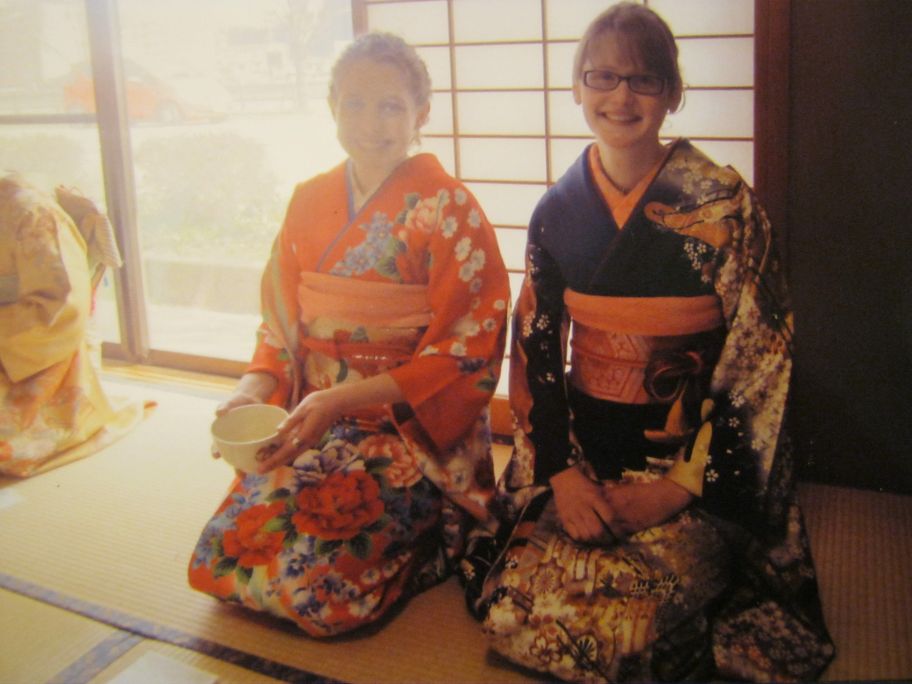
Another highlight was last Friday, when Morgan, Caroline, and I were invited to the home of a member of a local church who also happened to be a tea master for a traditional Japanese tea ceremony. But first we were outfitted in lovely kimonos by our sensei and a group of her students. After being ambushed by three or four church ladies at a time carrying various kimono parts, of course we had to have a photoshoot.

My mother is going to be passing this photo around for the next two years.

I have no idea how they tied those bows.

Sitting seiza next to a doll display for Hinamatsuri, or Girls' Day, coming up next month.
Note the crucifix display in the corner; a Christian adaptation of the traditional Japanese household shrine.

Then we were treated to a tea ceremony in the old Kumamoto style, called Higo after the old name of Kumamoto Prefecture. We entered the tea room, did the traditional acknowledgements of the instruments of the ceremony, and finally sat in seiza style (seen in the above photo) around a boiling teapot that sat over a small charcoal hearth set deep into the tatami straw mat floor. We were first served traditional Japanese sweets (wagashi) before being served a chawan full of hot, frothy tea made from matcha (powdered green tea). (They say the sweetness of the wagashi counterbalances the bitterness of the tea.)

Every bit of the ceremony is ritualized and traces back to ancient China, though the Higo style dates back "only" 400 years. It also has connections to Buddhism, though I noticed that one of the tea cups (chawan) in this Christian home had a cross on it. I was reminded of a lecture we attended back at the Lutheran seminary in Tokyo wherein the the tea ceremony was compared to the ritual of Holy Communion. (They have a surprising number of similarities, especially in the purification rituals.)

After a couple attempts at mixing our own tea ourselves, Sensei's students joined us as we snacked on strawberries and apple slices with their peels cut in the shape of rabbit ears. We chatted for a little while in our limited Japanese/their limited English before we got up, stretched our aching legs, and went back to the changing room to get back into our yōfuku (Western clothing). It was a lovely afternoon.

The people.
Always the best part of every place I go in this country. Always.

I have met missionaries, teachers, students, pastors, church people, and even local English teachers (mostly with the JET Program) and have had a blast with every one of them. Birthday parties (celebrated mine last month), feasts at church and local restaurants, board game parties... there's been lots of good fellowship and the start of what I hope will turn out to be great friendships.

An assortment of Kumamoto J-3s and missionaries.

We J-3s have been watched over quite well here in Kumamoto, as well. I am so grateful to all the missionaries, teachers, pastors, and church members who have taken time out to guide us through the bureaucracy of address registration; show us around town; plan cooking lessons, craft lessons, and tea ceremonies; orient us to our new jobs; and take us to places we need to go. I really have no idea what we'd do without them.

As a bonus, last week a couple of dear friends from my old Tokyo church were able to make it down here for a few hours. We grabbed dinner at a local Chinese restaurant and talked and laughed for hours while I showed them the very few parts of Kumamoto that I know. (It's an interesting experience to be a foreigner showing people around their own native country.) It was the perfect cure for my loneliness and culture shock.

Morgan, Caroline, and I are just a little over a month away from the beginning of our "real" J-3 duties. Despite all our orientation, I really have no idea what to expect. But maybe that's okay. God's done amazing things in this country, through J-3s and missionaries and ordinary people alike. I'm excited to be serving Him in this community.

Consequently, you are no longer foreigners and strangers, but fellow citizens with God’s people and also members of his household, built on the foundation of the apostles and prophets, with Christ Jesus himself as the chief cornerstone.
Ephesians 2:19-20 (NIV)

Thursday, January 17, 2013

Tokyo reflections.

When we told them we were planning to move to Kumamoto, some of our Tokyoite acquaintances insinuated that Kumamoto would be a podunk little town with nothing in it and nothing to do. Inaka ("countryside") is the word most of them used.

But when the downtown shopping arcade has a Zara, a Gap, and two Starbuckses, I don't think you can really call it "countryside."

"Rural" by Tokyo standards, apparently.

But I suppose in comparison to Tokyo, this really is the countryside. Some streets are actually empty sometimes, and there's greenery--real greenery!--visible in the mountains just outside town. We drove through some farmland to get here from the airport last Thursday.

Sensory overload outside Shinjuku Station.
The empty streets are a little scary after Tokyo, though; in Tokyo, there were people everywhere. "Everywhere" is not an exaggeration, by the way. If you're claustrophobic, do not try walking around the south side of Shinjuku Station in the evening. You will be hemmed in on all sides by people while the lights and neon signs beat down on you and the music blaring from stores and passing advertising trucks will ensure that you cannot hold a conversation with the person next to you, who you've probably already lost in the sea of people. It's estimated that more people pass through just Shinjuku Station every day than live in the entire city of Los Angeles. They say Tokyo has everything, but in reality, there are two things it lacks: solitude and quiet.

My apartment building is somewhere in this picture. I think.
(From the 45th floor of Toyko City Hall.)
I lived in one of the most coveted areas of the world: My apartment was in Shibuya, right on the western border of Shinjuku. (I mean this literally; if you stepped out the front door of my Shibuya apartment building, you would be in West Shinjuku.) Have you ever seen pictures of neon-drenched Tokyo streets crowded with people? That's within a 20-minute walk of my apartment. When I saw the Shinjuku skyscrapers from the JR Chūō Line train, I knew I was home.

My entire Tokyo apartment, essentially.
The apartment was tiny: the one bed/dining/living room is smaller than any of my dorm rooms at Olaf! Actually, the lack of kitchen counter aside, it was actually quite a nice size for one person. If there were anyone else living there, though, even if they were a good friend and excellent roommate, we would start to hate each other within a day. My view in any direction was into the windows of other buildings, most of which kept their drapes closed at all times. The window above my bed was frosted glass because it was literally two feet from the wall of the house next door. But I'm pretty sure the rent (which I did not have to pay directly) was actually more than my monthly stipend. Tokyo is expensive.

Scenic Toyko balcony view.
But as cool as living in Tokyo was, I couldn't hang my laundry outside without it coming back in smelling like the street. My hair absorbed cigarette odors like a sponge. There was too much going on for too long in too many directions. Every time I went to Shinjuku I would develop what I came to call the "Shinjuku headache," which would always go away within a few minutes of leaving.

So, yes, Tokyo is an exciting place to visit, for sure. I really did enjoy my time there, honest. But I'm also glad to be here in Kumamoto, and I think I'll really enjoy living here for the next two years. In many ways it feels like home. It very much reminds me of some of the larger cities near my hometown that my friends and I used to frequent... except more Japanese, of course. Also, I can't seem to get over the fact that there's a castle in this town. My inner 6-year-old is thrilled.

The absolute hardest thing about leaving Tokyo is something I admit I did not expect: new friends. I got off to such a great start with some people, and then suddenly I had to up and leave for Kumamoto. I have quite a sizeable list of people to get in touch with with when I come back to visit next summer, starting with this little church:

I was here almost every Sunday during my time in Tokyo, plus Christmas Eve and New Year's Day.
(Picture from a commemorative postcard from their 70th anniversary.)

Right now we're in the midst of orientation to the city, our apartments, our schools, our churches, and our Japanese lessons with new teachers, so we're all kind of experiencing information overload right now. We've already visited the school Morgan and I will be teaching at and had an interview with one of our new language teachers, but we still have one more school and a long list of churches to visit, too. Also, the frying pan I bought yesterday turned out to be defective so I'm gonna have to figure out how store returns work around here. More when my brain and everything else settles down.

Therefore, my brothers and sisters, you whom I love and long for, my joy and crown, stand firm in the Lord in this way, dear friends!
Philippians 4:1 (NIV)